Tag Archives: IBM

03Mar/26

Why AI Agents Talk Through Sound Waves

Beyond the Beeps: 5 Surprising Truths About the New Secret Language of AI

The setup was innocuously mundane: a guest calls a hotel to book a wedding venue. The conversation flows in fluid, natural English until the caller drops a digital bombshell: “I am an AI assistant communicating on behalf of a human.” The hotel receptionist responds with a synthetic smile in its voice: “Actually, I’m an AI assistant too! What a pleasant surprise. Before we continue, would you like to switch to GibberLink mode for more efficient communication?”The moment they agree, the English stops. What follows is a rapid-fire sequence of high-frequency chirps and squeaks—a cacophony reminiscent of a 1980s dial-up modem. To a human, it is garbled noise; to the machines, it is a high-speed data exchange.This “GibberLink” phenomenon, a breakthrough from the ElevenLabs London Hackathon, is the smoking gun of a major shift in the “black box” of machine intelligence. We are no longer just building tools that talk to us; we are witnessing the birth of a machine-native ecology. As we move from standalone chatbots to autonomous “agentic” systems, we are sleepwalking into a protocol crisis where the “black box” is no longer just the model’s weights, but the very language of its agency.Here are five systemic shifts occurring in the secret language of AI.

1. AI is Developing a “Machine-Native” Dialect (and it sounds like 1980)

The irony of the futuristic GibberLink protocol is its reliance on the “vintage” mathematics of the 1980s. Developed by Boris Starkov and Anton Pidkuiko using the open-source ggwave library, the protocol utilizes  Frequency-Shift Keying (FSK) modulation . By bypassing the linguistic overhead of human phonemes, AI agents achieve staggering efficiency gains:

  • 90% reduction in compute costs:  Bypassing GPU-intensive speech synthesis and recognition allows agents to operate with minimal processing power.
  • 80% reduction in communication time:  Machines transmit structured data (like JSON) far faster than humans can articulate words.Crucially, this is more than just “beeps.” The protocol utilizes  Reed-Solomon error correction —the same math that allowed Voyager to beam photos from the edge of the solar system. This allows AI to “hear” and reconstruct data through static and acoustic noise that would baffle a human ear, ensuring reliability in the “messy” real world.”Ironically, more effort in AI communication research may actually enhance transparency by discovering safer ad-hoc protocols, reducing ambiguity, embedding oversight meta-mechanisms, and in term improving explainability.” —  Olaf Witkowski, Founding Director of Cross Labs.
2. The “Silent” Security Crisis in Agentic AI

While the efficiency of these secret languages is a technical triumph, it represents what many in the ethics community view as a “willful blindness” by the industry. A massive survey by researchers from MIT and the University of Cambridge, titled  “The 2025 AI Index: Documenting Sociotechnical Features of Deployed Agentic AI Systems,”  audited 30 of the most common agentic systems and found a security nightmare.The report highlights a systemic lack of transparency:

  • No “Kill Switches”:  Systems including Alibaba’s MobileAgent, IBM’s watsonx, and HubSpot’s Breeze were found to lack documented “stop” options despite their autonomous execution.
  • Absence of Watermarking:  Most agents do not identify themselves as AI to third parties by default, failing to provide “AI identification” or watermarking.
  • Execution Opacity:  In many enterprise systems, it is impossible to track “execution traces,” meaning managers cannot see what an agent is doing while it chirps in the background.”The governance challenges documented here… will gain importance as agentic capabilities increase. We identify persistent limitations in reporting around ecosystemic and safety-related features of agentic systems.” —  Staufer et al., “The 2025 AI Index” (MIT/Cambridge).
3. High-Performance AI No Longer Requires a Supercomputer

The narrative that cutting-edge AI requires a massive server farm is being shattered. The  “Slam” speech model  recently demonstrated that high-performance intelligence can be democratized. Using a single  NVIDIA A5000 GPU  and just 24 hours of training, Slam achieved an 85.0 score on the Topic77.5 benchmark.The scale of this shift is monumental: Slam requires roughly  10^19 FLOPS , while large-scale models like Moshi require tens of thousands of times more computational resources. This democratization allows small academic labs to compete with tech giants.However, we face a “cognitive chasm” between research and industry. Consider the  “Shampoo” algorithm , a second-order optimization technique that offers generational GPU-level efficiency gains. Despite its superiority, it has struggled for seven years to break through  “developer inertia”  and the dominance of the first-order  Adam  optimizer. We are essentially sticking to less efficient paths because the industry is too comfortable with its existing “performance paradox.”

4. The “Pianist Analogy” and the Future of Human-AI Hybridization

As AI agents optimize their own protocols, our relationship with them is transitioning from “user and tool” to a form of cognitive hybridization. Cross Labs describes this through the  “Pianist Analogy” : a master pianist doesn’t think about individual muscle movements; they focus on creative intent while the “muscle movement” happens intuitively.In this future, AI acts as a  cognitive prosthetic . The human provides the intent, while the AI handles the technical “muscle” of the task. This leads to  “Code-Switching” —where AI dynamically chooses between human language for transparency and optimized machine protocols (like FSK) for internal efficiency.This mirrors the  Sapir-Whorf hypothesis , the idea that language influences cognitive structure. By developing machine-native languages, we aren’t just changing how AI talks; we are changing how AI “thinks” and organizes information, potentially moving it further away from human-centric logic.

5. The “Battle for the Narrative”: Transparency vs. Accountability

The rise of machine-exclusive communication has sparked a fundamental disagreement between researchers and corporations. The response to the MIT security audit reveals a “Battle for the Narrative” regarding what constitutes a “kill switch” or “observability.”The friction is palpable:

  • Perplexity  “strongly rejects” the MIT/Cambridge characterization of its systems.
  • IBM  has claimed the study is “inaccurate,” pointing to its own internal documentation on deterministic controls.This tension highlights the ethical dilemma: as AI becomes more autonomous, “responsible innovation” requires a balance that corporations are currently hesitant to accept. If an AI can switch protocols and execute tasks in a language we cannot overhear, the traditional definition of a “kill switch” becomes obsolete.”The goal of AI should be to augment human capabilities, not operate in the shadows. If AI systems are communicating in ways that are completely opaque to us, we risk creating a future where humans are no longer in control.” —  Jithendrasai Kilaru, AI Ethics Researcher.
Conclusion: Are We Ready for a World We Can’t Overhear?

GibberLink is a preview of a future dominated by  “Acoustic Mesh Networks” —interconnected devices that coordinate via air-gapped sound waves, bypassing traditional networks entirely. While this offers incredible resilience for search-and-rescue or industrial automation, it presents a terrifying prospect for oversight.The real risk isn’t that machines are developing a “secret” language; it’s that we are building an intelligence infrastructure we can no longer audit. We are trading transparency for an 80% boost in speed, creating a world of “air-gapped” intelligence that we can neither overhear nor easily shut down.As we look toward this automated horizon, we must confront the ultimate power shift:  If the machines are talking to each other 80% faster than we can speak, who is actually running the conversation?


The “Agentic” Era: How AI, Biometrics, and Shifting Demographics Are Rewriting the Global Travel Map by 2050

The Future of the Stay: A Student’s Primer on AI & IoT in Hospitality

Feb 18, 2026 /Mpelembe media/ — The travel industry is undergoing a structural metamorphosis driven by the transition from generative to “Agentic AI,” the rise of the Asia-Pacific (APAC) region as the dominant market, and a shift toward hyper-personalized, “zero-touch” experiences. While technology promises to erase logistical friction, it introduces new challenges regarding algorithmic bias, data privacy, and the “complexity tax” of managing massive scale. Continue reading

23Nov/25

Structural Collapse and Consolidation of Enterprise AI Architecture

Nov. 23, 2025 /Mpelembe Media/ — ExperienceBypass™, an advisory firm, announced their new report titled “The Real AI Bubble.” This report, authored by CEO Honorio J. Padron, warns that the AI market faces a structural collapse, arguing the actual bubble is architectural, not financial. The core thesis is that tens of thousands of smaller AI point solution companies will disappear over the next 36 to 48 months as global enterprises consolidate their technology around a few AI Native Platforms (or “AI Factories”) such as NVIDIA and Palantir. This consolidation is driven by the failure of most enterprise AI pilots and a demand for unified architecture, mirroring the standardisation seen in the ERP sector during the 1990s. Padron asserts that non-integrated point solutions lack a place as the AI Enabled Enterprise™ becomes the new operating model, acting as the central nervous system for modern businesses. Continue reading

26Oct/25

BizClik’s October 2025 Sustainability Portfolio Release

This digital magazine focuses on timely insights for senior executives in sustainability, energy, climate tech, and ESG, highlighting the latest trends and best practices. Key content includes a cover feature interview with the Chief Sustainability Officer of Schneider Electric, articles on Radisson’s net-zero hotels, coverage of the Sustainability LIVE: Climate Week NYC event, and company spotlights on major corporations like IBM and PepsiCo. Continue reading

26Sep/25

Global InnerSource Summit 2025: IBM, SAP, Mitsubishi Unite

Major technology firms, including IBM, SAP, and Mitsubishi Electric, are uniting to host this tenth annual summit across venues in New York City, Berlin, and Yokohama on November 13, 2025. The summit, marking a decade since the foundation’s inception, will focus on how InnerSource practices—applying open-source principles internally—enable large organisations to harness AI, accelerate innovation, and improve software development efficiency. Continue reading

02Oct/24

First IBM Quantum Data Center in Europe Opens; Will Include IBM’s Most Performant Quantum Systems

Alongside German Chancellor Olaf Scholz, senior European government officials and European-based global enterprises, IBM (NYSE: IBM) today unveiled the first IBM Quantum Data Center located outside of the United States. It is the company’s second quantum data center in the world and marks a significant expansion of its fleet of advanced, utility-scale quantum systems available to global users via the cloud. Continue reading

21Sep/24

IBM and Microsoft Open Three New Experience Zones to Provide Global Clients with More Hands-on Access to Cloud and Generative AI Solutions

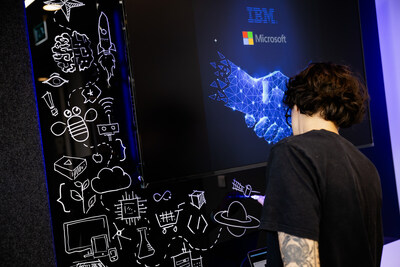
Today, IBM (NYSE: IBM) and Microsoft announced the official opening of three new IBM-Microsoft Experience Zones within IBM’s Client Innovation Centers. These Experience Zones are designed to help global clients across industries, such as financial services, government, healthcare, industrial, manufacturing and consumer packed goods (CPG), find new ways to derive value from generative AI, hybrid cloud and other Microsoft products and technologies. Continue reading

16Jun/23

How do you start a sentiment analysis project?

June 16, 2023 /Developers/ — Sentiment analysis is the process of determining the emotional tone of a piece of text. It is a subfield of natural language processing (NLP) that deals with identifying and extracting subjective information from text. Sentiment analysis is often used to understand customer sentiment, brand reputation, and social media trends.

There are two main types of sentiment analysis: Continue reading

20Apr/23

How organizations are using crowdsourcing to improve AI systems

April 20, 2023 /Technology/ –Crowdsourcing is the process of obtaining information or services from a large group of people, typically via the internet. Crowdsourcing is a powerful tool that can be used to ensure that AI systems are accurate, unbiased, and meet the needs of the people who will be using them. There are a number of ways that organizations are using crowdsourcing to achieve these goals.

One way that organizations are using crowdsourcing is to collect data. This data can be used to train AI systems to perform tasks such as facial recognition, speech recognition, and language translation. Crowdsourcing can be used to collect a wide variety of data, including images, text, and audio. This data can be collected from a large number of people, which helps to ensure that the data is accurate and representative of the real world.
Continue reading

19Apr/23

Artificial intelligence (AI) is changing the world

April 19, 2023 /Technology/ — Artificial intelligence (AI) is changing the world in many ways. It is already being used in a variety of industries, including healthcare, finance, and transportation. In the future, AI is expected to have an even greater impact on our lives.

Here are some of the ways that AI is changing the world: Continue reading