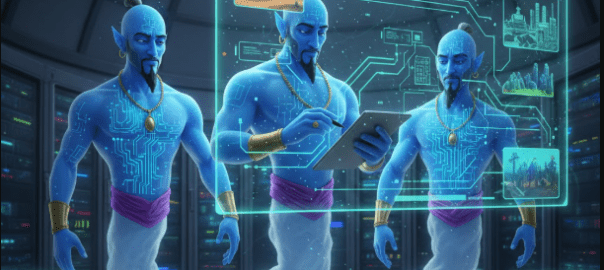
Jan. 1, 2026 /Mpelembe Media/ — The “Fifth Industrial Revolution” (5IR), is a shift from tools that we control to environments that control themselves. It frames the future not as a collection of gadgets, but as a totalizing system—the “Cathedral”—where the infrastructure itself makes moral and economic decisions. The Dark Industrial Cathedral is built on surveillance, extraction, and algorithmic control. The primary task for 5IR leaders is “engineering ethics into infrastructure” by embedding human values directly into the code. Continue reading
Beyond Automation: AI as the Operating System of Human Civilisation
Dec. 31, 2025 /Mpelembe Media/ — As of 2025, the global economy is projected to reach approximately $115 trillion, even as it faces a staggering $338 trillion in total debt. Within this landscape, artificial intelligence has emerged as the foundational infrastructure of a Fifth Industrial Revolution, with the AI economy expected to contribute over $15.7 trillion to global GDP by 2030. This technological shift is characterized by the rise of AI sovereignty, where control over data and models defines geopolitical power. While automation and AI agents enhance productivity and business valuations, they also present significant risks regarding cybersecurity and the potential erosion of human identity. Ultimately, society faces a critical choice between using these tools to foster human dignity or allowing them to create a future defined by algorithmic surveillance and control. Continue reading
Rokid’s Strategic Evolution: Merging Everyday Fashion with Advanced AI Wearables at CES 2026
Rokid will debut its new AI Glasses Style line at the CES 2026 conference in Las Vegas. These upcoming smart glasses are designed to blend fashionable aesthetics with high-tech augmented reality capabilities for everyday use. The announcement highlights the company’s recent success in mass-producing wearable devices and its growing global ecosystem of developers and users. During the scheduled event, the firm intends to share specific details regarding official pricing, prescription options, and retail availability. This new product line represents a strategic move to make artificial intelligence more accessible through lifestyle-oriented hardware. Continue reading
Realizing the American Dream: Siberian Immigrant Sergei Kaminskiy Acquires $4.8 Million Alabama Landmark
Entrepreneur Sergei Kaminskiy, a Siberian immigrant and CEO of the Kaminskiy Group, has purchased Alabama’s largest private residence for $4.8 million. Known as the “Guitar House” due to its uniquely shaped driveway, the 68,000-square-foot French château will undergo a massive restoration to become a luxury estate and wellness retreat. The project aims to blend the home’s original grand architecture with modern facilities like a biohacking center and a professional martial arts gym. Beyond a personal residence, Kaminskiy views this acquisition as a symbol of the American Dream and a headquarters for his business initiatives. The press release highlights his journey from arriving in the United States with very little to becoming a successful business leader with a massive social media presence. Under his design firm’s supervision, the property will eventually serve as an exclusive destination for elite entrepreneurs and athletes. Continue reading
Safari adventures and cultural excursions in Southern Africa
This 2026 travel program by Central Holidays invites you to embark on an extraordinary journey through some of the African continent’s most awe-inspiring landscapes. From the thrill of a safari in the Serengeti to the majestic roar of Victoria Falls, these itineraries are designed to offer authentic, sustainable, and life-changing experiences that celebrate the vibrant traditions and breathtaking natural wonders of Southern Africa. Continue reading
Private associations and secret societies in the era of AI
Dec. 30, 2025 /Mpelembe Media/ — Private associations and “secret brotherhoods” remain highly relevant and controversial in the modern era. AI might interact with these organisations in an age of data-driven transparency and AI-led surveillance, the human-to-human, unrecorded nature of secret brotherhoods might become even more relevant as a way for individuals to maintain private influence outside of digital footprints. However, you may want to independently verify how AI specifically impacts the social standing of such groups. Continue reading
Freemasons seek high court injunction against Met’s new membership disclosure policy.
Dec. 29, 2025 /Mpelembe Media/ — The Metropolitan Police is currently facing a legal challenge from the Freemasons regarding a new policy that mandates officers to disclose their membership in the organisation. This directive was introduced by Sir Mark Rowley to address concerns regarding institutional impartiality and historical allegations that such secret ties could foster corruption. In response, the Grand Lodge has applied for a High Court injunction, arguing that the rule constitutes religious discrimination because members must possess a faith to join. The organisation further accuses the police force of legitimising unfounded conspiracy theories and failing to conduct a proper consultation before implementation. Conversely, the Met maintains that the policy is a necessary step to bolster public trust and ensure that personal loyalties do not conflict with official duties. This dispute highlights long-standing tensions surrounding masonic influence within British law enforcement, dating back to investigations such as the Daniel Morgan murder inquiry. Continue reading
The AI Displacement Dilemma: Nearly Half of Workplace Skills Face Obsolescence by 2025
Dec. 29, 2025 /Mpelembe Media/ — This edX and Workplace Intelligence report examines how artificial intelligence is fundamentally transforming the modern professional landscape. The findings reveal a significant skill gap, as executives anticipate that nearly half of current workforce capabilities will be obsolete by 2025. While leadership believes many roles—including executive positions—could be automated, entry-level staff are particularly vulnerable to displacement. Despite a strong desire among staff to gain AI proficiency, many organisations currently lack the robust training and development frameworks necessary to support this transition. Ultimately, the research suggests that companies must prioritise internal upskilling to retain talent and remain competitive in an increasingly automated economy. Continue reading
Cybersecurity Forecast 2026: The Rise of AI Agents, Persistent Extortion, and Evolving Nation-State Tactics
Dec. 29, 2025 /Mpelembe Media/ — The Cybersecurity Forecast 2026 report by Google Cloud examines the anticipated evolution of digital threats, primarily focusing on the transformative role of artificial intelligence. It describes how adversaries will increasingly use AI agents for automated attacks and sophisticated social engineering, while defenders will adopt similar technology to enhance security operations. Beyond AI, the analysis highlights the persistent danger of ransomware and the expansion of cybercrime into the blockchain and virtualisation sectors. The document also evaluates the strategic motivations of nation-state actors from Russia, China, Iran, and North Korea as they pursue global espionage and disruption. Ultimately, the report serves as a guide for organisations to modernise their identity management and governance frameworks in response to these emerging risks. Continue reading
The Evolution of Vibe Engineering
Dec. 29, 2025 /Mpelembe Media/ — Artificial intelligence is fundamentally restructuring the software development lifecycle. Software engineering will become the primary application for AI, transitioning from simple code generation to sophisticated vibe engineering driven by natural language. This shift is expected to decrease computer science enrolment and significantly extend the time required to recruit developers as companies prioritise senior staff with AI expertise. Consequently, human roles will shift towards governance and architecture, necessitating a move toward as-code automation for nearly all enterprise development processes. To remain competitive, technology leaders are advised to modernise their hiring practices and integrate agentic development techniques immediately. Continue reading