Tag Archives: Artificial general intelligence

10Mar/26

Why AI Integration Depends on Zambian Copper

From Starlink to War Finance: Navigating the High-Stakes Paradox of the 2026 Economy

March 10, 2026 /Mpelembe Media/ —  The provided text serves as a digital business and technology analysis hub known as the Mpelembe Network, focusing specifically on the African market. This platform highlights current global trends ranging from the geopolitical impact of war and inflation to advancements in artificial intelligence and satellite communications. It organizes content through a diverse system of trending tags that cover various academic disciplines, specific geographic regions, and major tech corporations. By bridging the gap between economic theory and modern innovation, the source offers a comprehensive view of the interconnected global economy. This specific snapshot emphasizes the growing importance of secure AI applications and data science within the modern business landscape. Continue reading

09Mar/26

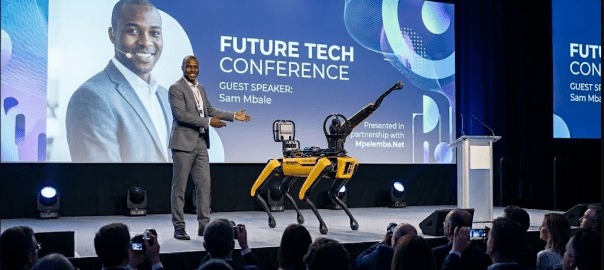
Inside ODSC 2026: The Ultimate Gathering of AI Builders and Visionaries

Beyond the Screen: 5 Surprising Realities Shaping the Future of AI and Robotics

March 9, 2026 /Mpelembe Media/ — For decades, the promise of the “robot age” has been stuck in an aggravating stalemate. We live in a world where an algorithm can compose a passable symphony or pass the bar exam, yet we still lack a machine that can reliably navigate a laundry room or patch a crumbling bridge. This is the “uncanny valley” of productivity: we have conquered the digital realm of symbols and logic, but the physical world—with its friction, gravity, and unpredictable messiness—remains stubbornly out of reach.But the screen is no longer a barrier; it is becoming a mirror. Recent breakthroughs presented by the world’s leading builders at ODSC 2026 and the Robotics and AI (RAI) Institute suggest we are finally witnessing the “tectonic shift” from artificial intelligence that merely thinks to intelligence that  does . We are moving beyond the era of chatbots and into the era of embodied partners. Here are the five surprising realities defining this new frontier. Continue reading

08Mar/26

Integrating AI Agents with Google Workspace via CLI and MCP

The AI Brain Meets the Real World: A Guide to Function Calling

March 8, 2026 /Mpelembe Media/ — The provided sources describe the emergence of AI agents designed to automate productivity tasks within the Google Workspace ecosystem. A central development is the release of gws, an open-source command-line interface that unifies various Google APIs into a single, machine-readable format. This tool allows large language models to interact directly with Gmail, Calendar, and Drive by providing structured JSON outputs and pre-built agent skills. Technical tutorials illustrate how developers can use the Vercel AI SDK and Model Context Protocol (MCP) to build assistants capable of managing schedules and conducting web searches. Furthermore, the integration of the Gemini CLI with tools like Google Sheets highlights a shift toward natural language data automation. Together, these resources mark a transition from manual API management to autonomous agentic workflows powered by generative AI. Continue reading

08Mar/26

Beyond the Demo: How to Build Secure AI Apps That Survive Production

Why Your AI-Generated Prototype Will Probably Fail in Production (and How to Fix It)

The provided text outlines an upcoming Supabase webinar scheduled for March 19, 2026, titled “Ship Fast, Stay Safe: AI Prototyping That Survives Production”. The event addresses how agencies can balance the rapid development speed of AI coding tools with the necessary control to build robust applications. Continue reading

03Mar/26

How DNA and Smartwatches Rewrite Health Insurance

March 2, 2026 /Mpelembe Media/ — By 2042, the global scientific community has undergone a profound transformation, shifting from a rigid, standardized “directed science” model to a “radically exploratory” paradigm. This evolution was catalyzed by a terrifying “crisis decade” (2026–2035) marked by intense political hostility, institutional stagnation, and the deadly resurgence of preventable diseases—like measles and whooping cough—due to declining vaccination rates. Forced to self-reflect, the scientific community rebuilt public trust by abandoning the pretense of absolute objectivity and instead embracing humility, uncertainty, and methodological pluralism.

Continue reading

02Mar/26

The Era of the Agentic Inference Cloud: How DigitalOcean is Democratizing AI for Developers

The Aspiring Learner’s Guide to AI Infrastructure: GPUs and Cloud Economics

The provided sources detail DigitalOcean’s comprehensive expansion into the artificial intelligence sector, transforming into an “Agentic Inference Cloud” tailored for AI-native businesses, developers, and startups. Following its acquisition of Paperspace, DigitalOcean has built a unified ecosystem that bridges affordable, high-performance GPU infrastructure with advanced tools for building and deploying AI agents. Continue reading

28Feb/26

The Spanish AI Loophole That Hacked Mexico

Hacker Weaponizes AI Chatbots to Steal Massive 150-Gigabyte Data Trove from Mexican Government

28 Feb. 2026 /Mpelembe Media/ —  An unknown hacker successfully breached multiple Mexican government agencies, stealing 150 gigabytes of sensitive information that included 195 million taxpayer records, voter data, government employee credentials, and civil registry files. Continue reading

28Feb/26

Velocity vs. Comprehension: The Rise of Cognitive Debt in AI-Assisted Software Development

The Fragile Expert: Why AI-Native Development is a Race Toward Cognitive Atrophy

28 Feb. 2026 /Mpelembe Media/ — We have discovered the “fast forward” button for digital production. Whether it is “vibe coding” a full-stack feature into existence or using an agentic swarm to refactor a legacy module, the experience is intoxicating. High-quality functional artifacts—code that executes, patterns that seem idiomatic—now appear with a keystroke.However, this skyrocketing velocity masks a burgeoning systemic risk. We are witnessing a decoupling of near-instantaneous algorithmic generation from the inherently slower human process of mental model construction. This is the “comprehension lag”: a state where our production speed outpaces our cognitive capacity to internalize the systems we build. By trading deep comprehension for “functional artifacts” we no longer cognitively own, we are accumulating an invisible and unsustainable liability. Continue reading

25Feb/26

The Watchers Exposed: How a Single Platform Connects ChatGPT Selfies to Federal Intelligence Reports

Your Chatbot is Filing Reports to the Treasury: The Hidden Architecture of AI Surveillance

25 Feb. 2026 /Mpelembe Media/ —  Security researchers have uncovered that Persona, the identity verification company used by OpenAI to screen users, operates a massive biometric surveillance and financial reporting platform for federal agencies using the exact same codebaseThe discovery was made through passive reconnaissance when researchers found an unprotected 53-megabyte file containing the platform’s entire original TypeScript source code left openly accessible on a FedRAMP-authorized government endpoint.

Continue reading

23Feb/26

The Invisible Disaster: AI Replacement Dysfunction and Worker Anxiety

23 Feb. 2026 /Mpelembe Media — Researchers have identified a burgeoning psychological crisis labeled AI replacement dysfunction (AIRD), which stems from the pervasive fear of professional obsolescence. This condition manifests as a specific cluster of symptoms including insomnia, paranoia, and a loss of identity triggered by the constant threat of automated labor. While not yet an official medical diagnosis, experts argue that the existential anxiety caused by industry leaders predicting massive job losses constitutes an “invisible disaster.” Evidence suggests that high-profile layoffs at major tech firms are already validating these fears and negatively impacting employee mental health. To address this, the authors advocate for specialized clinical screening to distinguish technology-related distress from traditional psychiatric disorders. Ultimately, the source emphasizes that the societal shift toward AI requires new community and medical frameworks to support a vulnerable workforce. Continue reading