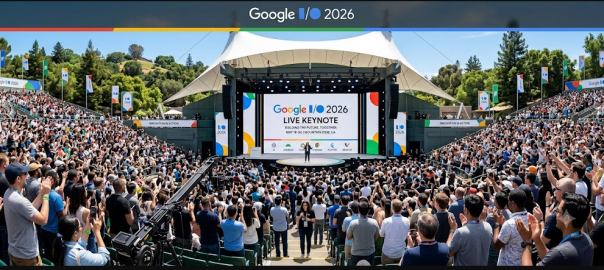

Tue, May 19 2026 /Mpelembe Media/ — Google I/O 2026 and the preceding Android Show marked a major pivot for Google towards an “agentic era,” where AI transitions from a passive assistant to a proactive, autonomous system. Google introduced advanced models like Gemini Omni and Gemini 3.5, which are designed to perform complex actions rather than just generating text. A major focus was placed on Google Antigravity, a development platform that enables creators to build autonomous agents for various tasks. These innovations extend across the company’s ecosystem, including intelligent eyewear, a universal shopping cart, and enhanced scientific research tools. Furthermore, the updates emphasize multimodal capabilities and new creative applications such as Google Pics and Stitch. Ultimately, the source portrays a future where proactive AI assistants are deeply integrated into search, hardware, and professional workflows. Continue reading
Tag Archives: Data science
A Parrot by Any Other Name: The Case for Stripping Personality from Artificial Intelligence
Why Your AI Doesn’t Actually “Feel” You—And Why That’s a Good Thing
March 10, 2026 /Mpelembe Media/ — Modern anxiety regarding AI largely stems from the psychological, societal, and security risks introduced by systems that convincingly mimic human emotion and cognition. Because human beings are biologically predisposed to anthropomorphize—projecting human intent and feelings onto non-human entities—the advanced capabilities of modern Large Language Models (LLMs) have created several unprecedented areas of concern: Continue reading
Why AI Integration Depends on Zambian Copper
From Starlink to War Finance: Navigating the High-Stakes Paradox of the 2026 Economy
March 10, 2026 /Mpelembe Media/ — The provided text serves as a digital business and technology analysis hub known as the Mpelembe Network, focusing specifically on the African market. This platform highlights current global trends ranging from the geopolitical impact of war and inflation to advancements in artificial intelligence and satellite communications. It organizes content through a diverse system of trending tags that cover various academic disciplines, specific geographic regions, and major tech corporations. By bridging the gap between economic theory and modern innovation, the source offers a comprehensive view of the interconnected global economy. This specific snapshot emphasizes the growing importance of secure AI applications and data science within the modern business landscape. Continue reading
The Era of the Agentic Inference Cloud: How DigitalOcean is Democratizing AI for Developers
The Aspiring Learner’s Guide to AI Infrastructure: GPUs and Cloud Economics
The provided sources detail DigitalOcean’s comprehensive expansion into the artificial intelligence sector, transforming into an “Agentic Inference Cloud” tailored for AI-native businesses, developers, and startups. Following its acquisition of Paperspace, DigitalOcean has built a unified ecosystem that bridges affordable, high-performance GPU infrastructure with advanced tools for building and deploying AI agents. Continue reading
The Invisible Disaster: AI Replacement Dysfunction and Worker Anxiety
23 Feb. 2026 /Mpelembe Media — Researchers have identified a burgeoning psychological crisis labeled AI replacement dysfunction (AIRD), which stems from the pervasive fear of professional obsolescence. This condition manifests as a specific cluster of symptoms including insomnia, paranoia, and a loss of identity triggered by the constant threat of automated labor. While not yet an official medical diagnosis, experts argue that the existential anxiety caused by industry leaders predicting massive job losses constitutes an “invisible disaster.” Evidence suggests that high-profile layoffs at major tech firms are already validating these fears and negatively impacting employee mental health. To address this, the authors advocate for specialized clinical screening to distinguish technology-related distress from traditional psychiatric disorders. Ultimately, the source emphasizes that the societal shift toward AI requires new community and medical frameworks to support a vulnerable workforce. Continue reading
CuraFlow AI: Orchestrating Clinical Care with Multi-Agent Intelligence
From Autopilot to Co-Pilot: Why Multi-Agent Orchestration is the New Standard for Clinical Excellence
Feb 19, 2026 /Mpelembe media/ — CuraFlow AI is an advanced healthcare orchestration platform designed to assist clinical professionals through multi-agent AI workflows. Powered by the Google Gemini API, the system automates a sequential clinical process involving specialized agents. Continue reading
Lyria 3 Enters the Fray: Google’s Multimodal Push into a Litigious, High-Fidelity AI Music Landscape
Feb 17, 2026 /Mpelembe media/ — Google DeepMind has introduced Lyria 3, a sophisticated artificial intelligence model designed for high-fidelity music generation. This technology allows users to transform text prompts or uploaded images into cohesive audio tracks with natural rhythmic flow. Creators can exercise technical control over specific details, such as vocal styles, linguistic nuances, and acoustic arrangements, to produce professional-grade compositions. To ensure ethical use, the developers integrated SynthID watermarking to identify AI-generated content and worked alongside musicians to establish creative guardrails. Beyond music, the broader ecosystem features specialized tools for scientific research, robotic reasoning, and environmental mapping. Consistent with its mission, the organization emphasizes responsible AI development that enhances human productivity and artistic expression. Continue reading
The “Agentic” Era: How AI, Biometrics, and Shifting Demographics Are Rewriting the Global Travel Map by 2050
The Future of the Stay: A Student’s Primer on AI & IoT in Hospitality
Feb 18, 2026 /Mpelembe media/ — The travel industry is undergoing a structural metamorphosis driven by the transition from generative to “Agentic AI,” the rise of the Asia-Pacific (APAC) region as the dominant market, and a shift toward hyper-personalized, “zero-touch” experiences. While technology promises to erase logistical friction, it introduces new challenges regarding algorithmic bias, data privacy, and the “complexity tax” of managing massive scale. Continue reading
The Fluid Future: A Learner’s Guide to Adaptive and Liquid AI Architectures
Why the $38 Billion BI Industry Failed Luxury—And How AI is Finally Fixing It
06, Feb. 2026 /Mpelembe Media — Digital Luxury Group (DLG) has announced the launch of LuxuryIQ MCP, the first AI data integration layer specifically designed for the luxury industry. Addressing the “data fragmentation” that 38% of luxury executives cite as a primary barrier to AI adoption, the platform consolidates 1.4 billion proprietary and public data points into a system accessible through natural language conversation. Continue reading