March 28, 2026 /Mpelembe Media/ — Organized crime groups, particularly the Calabrian ‘Ndrangheta and the Sicilian Cosa Nostra, have transformed from regional racketeers into sophisticated global enterprises. Central to their modern success is the “submersion” strategy—a tactical move away from overt, bloody violence toward the silent infiltration of the legal economy, public administration, and global financial systems.
Tag Archives: Canada
The UN Resolution on Slavery Reparations
UN General Assembly Makes History: Declares Transatlantic Slave Trade the “Gravest Crime Against Humanity”
March 27, 2026 /Mpelembe Media/ — On March 25, 2026, coinciding with the International Day of Remembrance of the Victims of Slavery and the Transatlantic Slave Trade, the United Nations General Assembly adopted a historic resolution declaring the transatlantic trafficking of enslaved Africans and racialized chattel enslavement as “the gravest crime against humanity”. Spearheaded by Ghana and heavily supported by the African Union and Caribbean Community (CARICOM), Resolution A/80/L.48 marks a significant shift in international human rights by calling for a comprehensive framework of reparatory justice.
From AI Hype to Strategic Execution: The New Rules of the Global Labor Market
Starlink Direct-to-Cell: Global Deployment and Performance Analysis
Your Smartphone’s Next Roaming Partner is 350 Miles Up: 5 Surprising Realities of Starlink’s “Cell Towers in Space”
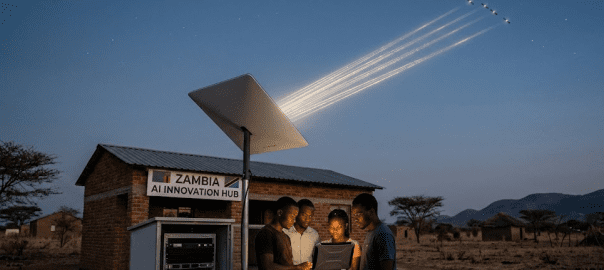
March 8, 2026 /Mpelembe Media/ — The provided sources examine the emergence and rapid expansion of Direct-to-Cell (D2C) technology, specifically focusing on Starlink’s efforts to provide Supplemental Coverage from Space (SCS). Research highlights that these satellite-based networks allow unmodified 4G LTE smartphones to connect directly to orbiting satellites, effectively eliminating terrestrial dead zones in remote areas like national parks. While initial commercial services in the United States and New Zealand focused on text messaging and emergency alerts, the technology is evolving to support voice, high-speed data, and IoT applications. Significant milestones include Airtel Africa and MTN Zambia partnering with SpaceX to launch services across the African continent, successfully piloting the first satellite-based fintech transactions. Despite technical hurdles like lower signal power and Doppler shifts, regulatory bodies worldwide are modernizing frameworks to accommodate this hybrid orbital-terrestrial model. Ultimately, these sources position D2C as a transformative tool for global digital inclusion, promising near-universal connectivity without the need for traditional ground infrastructure.
The Board of Peace is Bombing Iran for the Gaza Riviera
5 Radical Realities Reshaping the Middle East
The Watchers Exposed: How a Single Platform Connects ChatGPT Selfies to Federal Intelligence Reports
Your Chatbot is Filing Reports to the Treasury: The Hidden Architecture of AI Surveillance
From Companions to Liabilities: Suicides Linked to AI Chatbots Spark a Legal and Regulatory Reckoning
The 2026 AI Reckoning: 5 Takeaways That Are Redefining the Future of the Internet
Feb. 24, 2026 /Mpelembe Media/ – This report details how OpenAI internally questioned whether to alert authorities regarding the disturbing chat logs of a teenager who later committed a mass shooting in Tumbler Ridge, Canada. Although the suspect’s account was terminated months before the attack due to violent content, the company ultimately decided her behavior did not meet the specific threshold for an emergency police referral at that time. Beyond her interactions with artificial intelligence, the perpetrator had established a concerning digital history through violent simulations on Roblox and firearms-related posts on social media. The situation has reignited a broader debate concerning the ethical responsibilities of tech companies in monitoring user data to prevent real-world tragedies. Currently, the organization is cooperating with the Royal Canadian Mounted Police as investigators review the digital warning signs that preceded the event. Continue reading
The Great Tariff Refund: Navigating the Supreme Court Ruling
The $180 Billion Reversal: What the SCOTUS Tariff Ruling Actually Means for the Future
Feb 20, 2026 /Mpelembe media/ — On February 20, 2026, the U.S. Supreme Court issued a landmark 6-3 decision in the consolidated cases of Learning Resources, Inc. v. Trump and Trump v. V.O.S. Selections, Inc., striking down the sweeping global tariffs implemented by the Trump administration. Chief Justice John Roberts authored the majority opinion, which ruled that the International Emergency Economic Powers Act (IEEPA) does not grant the President the authority to unilaterally impose tariffs. The Court emphasized that while IEEPA allows the President to “regulate” commerce during national emergencies, it does not transfer Congress’s exclusive constitutional power to levy taxes and duties to the Executive Branch. Continue reading
Magic in the Mundane: Mackenzie Crook’s Small Prophets Brings Gentle Alchemy to Suburbia
From Metal Detecting to Manure Jars: Why Mackenzie Crook’s New ‘Small Prophets’ is the Most Surprising Show of 2026
Feb 15, 2026 /Mpelembe media/ — There is a specific, heavy stillness that descends upon a life after a profound loss—a feeling of being trapped in the amber of one’s own grief while the rest of the world moves forward. In the Greater Manchester suburb of Urmston, Michael Sleep has existed in this state of enchanting stasis for seven years, ever since his partner, Clea, vanished without a trace. His world is a repetitive loop of ordinary suburban ritual: Shreddies for breakfast, shifts at a massive DIY superstore, and visits to his father in a care home, punctuated only by the presence of his dilapidated Ford Capri. Continue reading
From Apartheid Enclaves to Global Influence: Elon Musk’s Enduring Impact on South African Policy
Feb 11, 2026 /Mpelembe media/ — In its August 2025 proposal to South African regulators, SpaceX offered a multi-billion rand investment package designed to meet the country’s empowerment requirements through infrastructure and connectivity projects.
The specific infrastructure and investments offered included: Continue reading