Tag Archives: Generative AI

02Sep/26

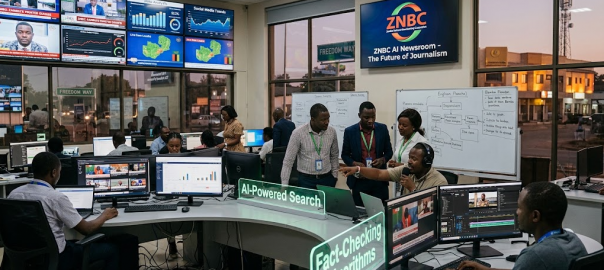
Newsrooms fight for survival against AI

Ethics in Action: Preserving Human Judgment Amid the Rise of Generative News

Tue Sep 01 2026 /Mpelembe Media/ — The global expansion of artificial intelligence has created a landscape of digital hegemony where standard-setting and economic benefits are heavily concentrated in the Global North, establishing a form of digital extractivism that mirrors historical colonial dynamics. Large technology conglomerates utilize content harvested from global networks to train proprietary models and sell them back as subscriptions. This extraction is accompanied by a severe decline in search referral traffic, which has collapsed by 50% to 60% in critical emerging markets like Brazil, South Africa, and Indonesia. This occurs because conversational search engines summarize copyrighted reporting directly on results pages, bypassing clicks to the original publisher. In response, major nations in the Global South are reframing the AI debate, moving from historical strategies of diplomatic non-alignment directly into the digital realm. Media leaders and policymakers in these regions argue that AI must not be treated as an isolated technical novelty, but as a critical national sovereignty, labor, and industrial policy issue that fundamentally impacts the health of local information environments. Continue reading


Million dollar solo startups through AI

The Million-Dollar Solopreneur: Building Full-Stack Software on the Limits of Vibe Coding

Mon Aug 31 2026 /Mpelembe Media/ — The transition of software from traditional SaaS to AI-native applications is driving a massive economic shift by turning “Services-as-Software.” Historically, software has struggled to penetrate the service-based sectors that make up nearly eighty percent of the modern economy due to complex reasoning and unstructured data bottlenecks. Today, early generative AI winners are disrupting these legacy industries by building compound AI systems that combine multiple model calls, retrieval-augmented generation (RAG), and external tool interfaces rather than relying on a single monolithic model. Pioneering applications like Co:Helm in healthcare prior authorizations, EvenUp in personal injury legal work, and Eleos Health in behavioral therapy scribe intelligence are actively capturing immense professional service budgets by automating high-value, pattern-based, or high-volume workflows. These companies are growing faster than any previous wave of SaaS startups, capturing valuable proprietary datasets and creating lasting moats through habitual daily usage and zero-marginal-cost content creation. Continue reading

29Aug/26

How AI tokens and pixels drain budgets

The $30,000 Loop: How Google’s 2026 Prepay Mandate is Forcing an AI FinOps Revolution

Sat Aug 29 2026 /Mpelembe Media/ — The financial landscape of generative AI development is undergoing a massive shift as cloud providers migrate developers from traditional postpay structures to strict prepay billing systems, with Google AI Studio setting a hard cutover deadline of September 14, 2026. This transition forces developers to upgrade to paid tiers by prepaying a minimum of $10 to establish a positive credit balance, moving them through dynamic usage tiers based on cumulative spend and account age to secure advanced rate limits and enterprise-grade data privacy. The operational challenge of this model is its absolute zero-tolerance policy: when the prepaid balance hits $0, all connected API keys in linked projects stop working simultaneously. This introduces significant downtime risk to production workflows, especially since the typical 10-minute latency in billing pipelines allows long-running batch processes and autonomous agent sessions to run up overages before the system can process the depletion and halt usage. Continue reading

Building bulletproof billing for AI

The Webhook and Metering Playbook: Scaling Gemini Applications with Resilient Stripe Architecture

Fri Aug 27 2026 /Mpelembe Media/ — Integrating Stripe into generative AI applications powered by Google Gemini requires a strict architectural separation between user-facing interfaces and backend payment pipelines to protect sensitive keys and prevent exploitation.

Storing Stripe secret keys, Gemini API credentials, or performing payment orchestrations directly on the client side introduces critical security vulnerabilities, allowing malicious actors to manipulate price details, bypass paywalls, or run unauthorized, high-volume model executions. To build a resilient defense, developers must funnel all checkout, subscription, and credential-heavy actions through a server-side intermediary, such as a FastAPI backend or a serverless environment like Firebase Cloud Functions. This intermediary securely handles Stripe Checkout Session creation with server-side price validation, returning a hosted, pre-built payment URL to redirect the customer safely. Continue reading

28Aug/26

Your AI intern is managing your mind

Algorithmic Elenchus: Deconstructing Structural Incentives and Substantive Due Process in Comparative Law

Thu Aug 27 2026 /Mpelembe Media/ —  The 2026 Zambian presidential election was defined by major legal and structural changes that occurred shortly before the vote. Under Constitutional Amendment Act No. 13 of 2025 and the subsequent May 2026 Electoral Processes Act, the electoral boundary map was dramatically redrawn, expanding the constituency seats from 156 to 226 just three months prior to the election. Following the vote, tension escalated when the Electoral Commission of Zambia (ECZ) suspended vote counting for six hours on August 14 before declaring incumbent Hakainde Hichilema the victor with 60.49% of the vote. In response, opposition leader Brian Mundubile prepared to file a formal challenge in the Constitutional Court. However, on the final day of the mandatory seven-day filing window, police citing “security reasons” physically sealed the top courts, blockading access and forcing the opposition to resort to an unprecedented digital petition sent directly to the Chief Justice’s personal email. Continue reading

24Aug/26

Why AI labels tank game sales

“AI Slop” Backlash: How Player Outrage is Forcing Developers to Put Human Artists First

Sun, Aug 23 2026 /Mpelembe Media/ — The video game industry is undergoing a swift legal and structural recalibration as “anti-AI” clauses rapidly transition from bespoke risk-mitigation measures into standard contract boilerplate. Corporate intellectual property lawyers, such as Haley MacLean of Voyer Law, report that nearly all of their game development and publishing clients now explicitly mandate strict bans on generative AI. This shift is primarily driven by massive intellectual property liability: under current U.S. copyright law, works must be the product of human authorship to receive IP protection. If a developer incorporates AI-generated assets like art, writing, or sound without substantial human editing, those elements fall into the public domain. Consequently, competitors could legally extract those identical assets and use them in their own games with no legal recourse for the original creator, rendering unedited AI assets a major commercial risk for publishers and investors alike. Continue reading

22Aug/26

The AI X-ray for your relationship

Decoding the Digital Heart: How AI is Quantifying Intimacy and Rewriting the Science of Connection

Sat, Aug 22 2026 /Mpelembe Media/ — The landscape of digital mental health is undergoing a profound shift, transitioning from rigid, scripted chatbots to highly conversational generative artificial intelligence systems powered by large language models. Modern therapy applications—such as Ash, Wellness AI, and Noah AI—can now engage in fluid, open-ended dialogues, retain conversational context across multiple sessions to reference long-term behavior patterns, and generate automated session summaries. Crucially, while some veteran platforms rely on highly structured clinical exercises—such as Wysa, which boasts an FDA Breakthrough Device designation and over 45 peer-reviewed studies—newer platforms focus on multimodal features like voice-first modes and custom guided meditations generated in real time directly from a user’s therapy discussion. This technological evolution offers unprecedented accessibility but also highlights clear differences in conversational depth, session memory, and data privacy policies between fully generative systems and traditional hybrid models. Continue reading

18Aug/26

The AI girl who crashed Bama Rush

From ChatGPT to ‘Most Popular Sorority Star’: How a Synthetic Influencer Hijacked the TikTok Algorithm

Tue, Aug 18 2026 /Mpelembe Media/ — The viral annual sorority recruitment cycle at the University of Alabama, historically known as “Bama Rush,” became the backdrop for a groundbreaking sociotechnical experiment in August 2026. Inspired by a social media post from venture capitalist Justine Moore of Andreessen Horowitz suggesting that the highly publicized, competitive rush cycle could be entirely simulated using generative artificial intelligence, her sister and consumer tech investing partner Olivia Moore launched a live, multi-day social experiment featuring @janie.b086—a fictional 19-year-old Potential New Member (PNM) named Janie. Building on a less-sophisticated AI experiment from the previous year named Tinsley, Olivia designed Janie to explore the boundaries of human media literacy, algorithmic indexing, and platform-level content moderation on TikTok. Within a single week, the fictional redhead fumbled popular dances and posted breathless outfit-of-the-day (OOTD) videos, amassing 1,300 followers and tens of thousands of views per video, and even prompting the Daily Mail to crown her Alabama’s “most popular sorority star”. Continue reading

06Aug/26

AI Automates the Industrialized Cybercrime Economy

Coordinated Policing Battles a Surge in Sophisticated, AI-Powered Scams Across Africa

Thur , Aug 06 2026 /Mpelembe Media/ — Artificial intelligence has become the primary engine transforming cybercrime across Africa, driving 55 percent of all reported digital offenses and shifting the threat landscape from isolated incidents into an industrialized, borderless criminal ecosystem. This automation spans every stage of a cyberattack, from initial target reconnaissance and highly personalized phishing generation to execution, extortion, and operational evasion. Fueled by the continent’s rapid digital transformation, which reached over 1.1 billion registered mobile subscribers in 2025, cybercriminals have successfully scaled their operations to target massive audiences simultaneously. This has resulted in a devastating financial toll, with annual regional losses skyrocketing from $192 million in 2024 to $484 million in 2025, while the number of identified individual victims surged from 35,000 to 87,000. Continue reading

04Aug/26

The hidden tax of AI tech debt

The Jagged Technological Frontier: Why the AI Era Demands a Supreme Premium on Human Judgment

Tue , Aug 04 2026 /Mpelembe Media/ — The integration of generative artificial intelligence into highly skilled professional workflows has illuminated a “jagged technological frontier,” where AI dramatically enhances performance on tasks within its capability boundary but causes silent, severe performance degradation on tasks lying just beyond it. While early organizational studies celebrated substantial speed and quality gains on rote assignments, actual longitudinal production data has exposed a stark AI productivity paradox. In areas like software development, experienced developers frequently report feeling significantly faster while objectively measuring slower due to a massive increase in code churn, a surge in copy-pasted duplication, and a severe reduction in refactoring. These trends rapidly compound long-term technical debt and inject latent vulnerabilities into production systems, demonstrating that accelerating raw output without rigorous, expert validation ultimately introduces severe operational bottlenecks. Continue reading