Category Archives: Innovation

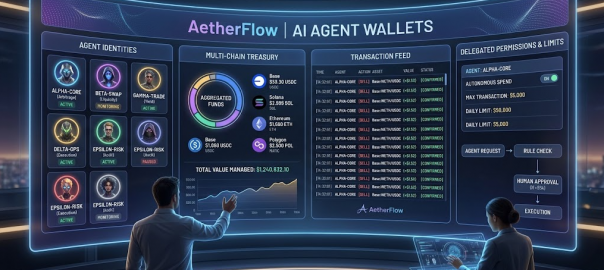
Gasless AI agent wallets with AetherFlow

Bridging Protocol and Client: The Multi-Layer Blueprint for Zero-Friction Autonomous Transactions

Mon Aug 31 2026 /Mpelembe Media/ — The convergence of EIP-7702 and ERC-7677 represents a massive leap forward for decentralized finance and autonomous agent architectures, fundamentally transforming how traditional wallets interact with smart contract capabilities. EIP-7702 serves as an on-chain upgrade mechanism, utilizing Type-4 transactions and 0x05 authorization tuples to temporarily delegate smart contract code to standard Externally Owned Accounts. This protocol-level shift allows everyday users to immediately benefit from atomic transaction batching and robust session key management without going through the friction of migrating assets to an entirely new smart contract wallet. Furthermore, delegating execution authority to ephemeral session keys creates a highly secured operating model where the blast radius of a potential compromise is strictly contained, safeguarding the user’s primary treasury. Continue reading
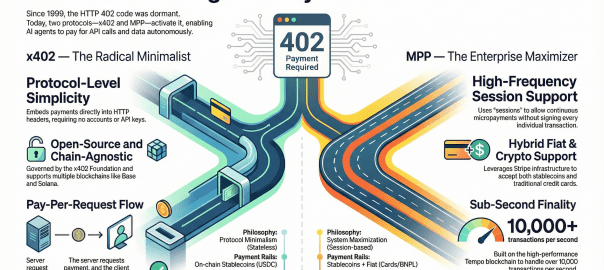

How AI agents spend real money

Mon Aug 31 2026 /Mpelembe Media/ — Stripe has positioned itself as the economic infrastructure layer for the artificial intelligence era, building a comprehensive suite of products designed to handle both the expense and income sides of autonomous agent commerce.

Rather than forcing developers to choose strictly between crypto-native or legacy card networks, Stripe bridges both systems. The core of Stripe’s production-ready agentic framework operates across several key pillars: Continue reading

30Aug/26

AI Agents and Unified Film Pipelines

The AI Film Production Operating System
Automating Independent Cinema: How Real-Time Collaborative Operating Systems Compress Production Timelines by 50%

Sun Aug 30 2026 /Mpelembe Media/ —The emergence of digital filmmaking operating systems in 2026 represents a paradigm shift where traditional, fragmented production pipelines are replaced by a unified, AI-driven software stack. Rather than relying on expensive contractor day-rates and physical gear rentals, indie filmmakers utilize a centralized stack of twelve high-leverage software engines to execute everything from pre-visualization to post-production. This modern framework compresses mid-budget pre-production timelines from 16–20 weeks down to 8–11 weeks, drastically reducing administrative overhead and crew holding fees. In the NeoMovie software ecosystem, this transformation is driven by a specialized 12-tool software stack, consisting of Claude and ChatGPT for script analysis and brainstorming, Filmustage for screenplay breakdowns, Midjourney and Canva for anamorphic keyframe pre-visualization, Luma AI for smartphone-based 3D location scouting, Runway and Luma Dream Machine for b-roll generation, Suno and Udio for scoring, ElevenLabs for voice cloning, DaVinci Resolve for editing and rotoscoping, Topaz Video AI for 4K upscaling, Descript for text-based editing, and OpusClip for trailer marketing. By deploying these twelve software engines at a consolidated cost of $185 to $210 per month, an independent filmmaker can avoid more than $54,200 in traditional contractor costs across pre-production, filming, post-production, and marketing phases. On-set operations benefit enormously from this workflow efficiency, which has been shown to reduce average scene turnaround times from 3.5 days to just 1.1 days. Continue reading

28Jul/26

Why innovation needs useless knowledge

The Power of Curiosity: Why “Useless” Knowledge is the Engine of Human Progress

Tue, July 28 2026 /Mpelembe Media/ — This is a comprehensive analysis of the distinction between basic and applied research, outlining their unique motivations, methodologies, and societal roles. Basic research is described as a curiosity-driven endeavor aimed at expanding the frontiers of human knowledge and establishing theoretical foundations without immediate concern for utility. In contrast, applied research focuses on utilizing existing scientific frameworks to engineer practical solutions for specific, real-world challenges. The articles emphasize that these two approaches exist on a dynamic continuum, where fundamental discoveries frequently pave the way for later technological and medical breakthroughs. By examining various disciplines such as medicine, social sciences, and engineering, the texts illustrate how a balanced research ecosystem relies on the symbiotic relationship between pure intellectual inquiry and targeted problem-solving. Ultimately, the collection highlights that while their timelines and goals differ, both forms of investigation are essential for continuous innovation and the advancement of the human condition. Continue reading

30May/26

Semiconductor Chokepoints and Google Willow

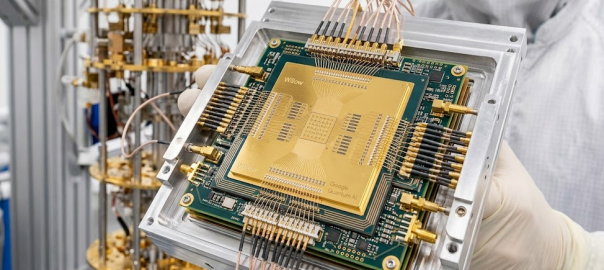
King’s College London Pioneers UK Quantum Research with Access to Google’s 105-Qubit Processor

Sat, May 30 2026 /Mpelembe Media/ — Technical Breakthroughs and Error Correction: Google’s Willow is a 105-qubit processor that represents a major milestone in hardware stability. Its most significant achievement is in quantum error correction—demonstrating that as the system scales and adds more qubits, the error rate exponentially decreases. Leveraging a new algorithm called Quantum Echoes, Willow achieved “verifiable quantum advantage” by modeling complex physical experiments 13,000 times faster than the world’s best classical supercomputers. Continue reading

08Apr/26

Five cent AI and the compliance trap

April 8, 2026 /Mpelembe Media/ — This is a comprehensive overview of the 2026 generative AI landscape, heavily focusing on Google’s latest media models, enterprise orchestration, and the broader impacts of AI on industry and regulation. This article analyses a report from Google Cloud titled “Transformation Today,” which highlights new generative media tools available on Vertex AI. The primary focus is the launch of the Lyria 3 Pro and Veo 3.1 Lite models, designed for advanced music and video creation. It categorizes the Veo 3.1 family into three tiers—standard, fast, and lite—to help developers balance visual quality, processing speed, and cost. Additionally, the text offers a specific prompting formula to help users achieve better control over cinematic elements and subject actions. Technical experts contribute to the guide, providing frameworks for applying these AI innovations to professional workflows. Overall, the document serves as an educational resource for engineers looking to integrate high-volume video generation into their applications.
Continue reading

10Mar/26

Why AI Integration Depends on Zambian Copper

From Starlink to War Finance: Navigating the High-Stakes Paradox of the 2026 Economy

March 10, 2026 /Mpelembe Media/ —  The provided text serves as a digital business and technology analysis hub known as the Mpelembe Network, focusing specifically on the African market. This platform highlights current global trends ranging from the geopolitical impact of war and inflation to advancements in artificial intelligence and satellite communications. It organizes content through a diverse system of trending tags that cover various academic disciplines, specific geographic regions, and major tech corporations. By bridging the gap between economic theory and modern innovation, the source offers a comprehensive view of the interconnected global economy. This specific snapshot emphasizes the growing importance of secure AI applications and data science within the modern business landscape. Continue reading

08Mar/26

Starlink Direct-to-Cell: Global Deployment and Performance Analysis

Your Smartphone’s Next Roaming Partner is 350 Miles Up: 5 Surprising Realities of Starlink’s “Cell Towers in Space”

March 8, 2026 /Mpelembe Media/ — The provided sources examine the emergence and rapid expansion of Direct-to-Cell (D2C) technology, specifically focusing on Starlink’s efforts to provide Supplemental Coverage from Space (SCS). Research highlights that these satellite-based networks allow unmodified 4G LTE smartphones to connect directly to orbiting satellites, effectively eliminating terrestrial dead zones in remote areas like national parks. While initial commercial services in the United States and New Zealand focused on text messaging and emergency alerts, the technology is evolving to support voice, high-speed data, and IoT applications. Significant milestones include Airtel Africa and MTN Zambia partnering with SpaceX to launch services across the African continent, successfully piloting the first satellite-based fintech transactions. Despite technical hurdles like lower signal power and Doppler shifts, regulatory bodies worldwide are modernizing frameworks to accommodate this hybrid orbital-terrestrial model. Ultimately, these sources position D2C as a transformative tool for global digital inclusion, promising near-universal connectivity without the need for traditional ground infrastructure.

How does Starlink’s direct-to-cell technology work with unmodified smartphones?
What are the expected data speeds for satellite-to-mobile services?
How is this technology being used for emergency response and fintech?

Continue reading

28Feb/26

Inside the Silicon Boardroom: A Glimpse into the Alpha Flare Network Dashboard

Syncing with Lord Silicon: 3 Secrets Inside the 2026 Alpha Access Boardroom

27 Feb. 2026 /Mpelembe Media/ —  The mahogany-clad boardroom is dead; long live the digital node. As we navigate the volatile waters of 2026, the “Silicon Boardroom” has emerged as the definitive venue for a new breed of decentralized organization. This isn’t just a UI update—it’s a fundamental pivot toward “Alpha Access” environments that prioritize automated precision over old-world corporate bureaucracy. Continue reading

19Feb/26

MonetizationOS Launches Free Paywall Infrastructure to Combat Bot-Driven IP Theft

The “Seat” is Dead: 5 Surprising Truths About Monetizing Software in 2026

Feb 19, 2026 /Mpelembe media/ — Most SaaS founders approach their billing infrastructure with the same level of strategic rigor they use to pick lunch: they go with what’s familiar, what’s easy, or what their neighbor recommended. But in 2026, treating billing as a back-office utility rather than a core product feature is a recipe for subsidized growth and eventual insolvency. For a company at $2M in Annual Recurring Revenue (ARR), the cost of this “lunch-pick” mentality is staggering—up to $100,000 lost every year due to billing errors, missed renewals, and failed payments.We have entered a landscape where the “physics of compute” has rewritten the rules of the game. As venture-backed startups navigate a world dominated by AI and usage-driven models, the traditional seat-based license has become a relic. To thrive, founders must move past simple subscription summaries and understand that monetization is now a continuous discipline of research, iteration, and negotiation. Continue reading