All posts by admin

26Oct/26

Audi Ditches Its Logo in China

The Great Automotive Realignment: How China Upended Germany’s Global Car Supremacy

Mon, July 26 2026 /Mpelembe Media/ — For decades, German automotive giants—Volkswagen Group, BMW, and Mercedes-Benz—dominated the global industry and derived a significant share of their corporate profits from mainland China. However, a severe structural contraction has destabilized this industrial core, culminating in a 76% year-on-year collapse in combined Q3 operating profits down to €1.711 billion. China’s share of total global vehicle deliveries for German carmakers dropped from 39% in 2020 to 29% in 2025, with quarterly deliveries in China plummeting between 30% and 41% by mid-2026. Domestically, annual German passenger vehicle output fell from 5.6 million units in 2017 to 3.4 million in 2024, burdened by high labor costs averaging €62 per hour and severely underutilized assembly plants—such as Wolfsburg operating at just 61% capacity—compelling Volkswagen to shutter a domestic manufacturing plant in Germany for the first time in its 88-year history. Continue reading →

26Oct/26

Vibe Coding and the Slopsquatting Threat

Eulogy for the Syntax Coder: Architecting Code Quality, Supply Chain Security, and Human Taste in an Agentic World

Mon Oct. 26, 2026 /Mpelembe Media/ — The software engineering profession is undergoing a profound structural shift where manual code drafting, boilerplate execution, and routine syntax assembly are reaching technical obsolescence. Rather than destroying the discipline, generative AI and autonomous agentic workflows are elevating the role of the developer from a tactical syntax writer to a strategic director and systems curator. While informal “vibe coding”—building applications purely through conversational natural language prompts—accelerates initial prototyping, it relies on unverified outputs that frequently introduce subtle defects and structural brittleness. In contrast, professional “Agentic Engineering” treats multi-agent AI ensembles as execution engines that require continuous boundary definitions, formal specifications, and multi-layered verification pipelines to ensure production viability. Continue reading →

26Oct/26

How Freemasons Legally Keep People Out

Jurisdictional Sovereignty and Institutional Governance in Freemasonry

Freemasonry operates through a supreme, decentralized network of autonomous regional governing bodies known as Grand Lodges, each holding sovereign administrative, legislative, and judicial jurisdiction over its constituent local lodges. Local lodges function under the constitutional mandates, statutory codes, and bylaws established by their overarching Grand Lodge, which define standards for ritual conduct, administrative reporting, officer duties, and internal discipline. Internal governance balances executive authority—exercised locally by the Worshipful Master and regionally by District Deputy Grand Masters and the Grand Master—with formal administrative and judicial mechanisms. This structural arrangement mandates that all Masonic proceedings strictly adhere to established organizational law and ancient landmarks. Continue reading →

26Oct/26

How Noisy Neighbors Destroy Property Value

Capital Quiet List Revealed: Leafy Outer Boroughs Lead London in Safety, Parkland, and Nighttime Peace

Sat Oct. 24, 2026 /Mpelembe Media/ — Richmond upon Thames has been crowned London’s most peaceful borough in a comprehensive study evaluating residential tranquility across England and Wales. Richmond earned the top position in the capital with a peace score of 58.1 out of 100, followed closely by Havering (56.5) in second place and Merton (56.3) in third. The top ten list of London’s quietest boroughs is rounded out by Redbridge (55.9), Bromley (50.3), Sutton (49.8), Harrow (42.5), Barking and Dagenham (40.4), Hillingdon (39.2), and Barnet (37.7). Continue reading →

25Oct/26

Where Foreign Influence Becomes Illegal

Allegations, Cyber Surveillance, and Denials: The Conflict Over Jared Kushner’s Middle East Financial Dealings

Sat Oct. 24, 2026 /Mpelembe Media/ — An excerpt published by Vanity Fair from journalist Matthew Cole’s book Princes and Thieves alleges that former White House senior adviser Jared Kushner had access to undisclosed foreign bank accounts holding up to $2 billion supplied by Gulf leaders during Donald Trump’s first presidential administration. According to these claims, Dutch military intelligence (MIVD) intercepted Kushner’s personal smartphone activity starting in 2018 after discovering device screenshots stored on a Russian military intelligence (GRU) server in Rostov. Spies reportedly observed Kushner accessing Account Alpha at First Abu Dhabi Bank—which contained roughly $750 million under the cover of an Emirati charitable foundation with funds routed via Azerbaijani banks—as well as Account Beta, an estimated $1 billion repository at the Bank of Israel reportedly subject to transaction oversight by Israeli Prime Minister Benjamin Netanyahu. Continue reading →

25Oct/26

Racial Census Categories and Africa’s Economic Future

Deconstructing Digital Demography: How Viral Visualizations Distort Ethnic and Migration Data

Sat Oct. 24, 2026 /Mpelembe Media/ — The historical development of ethnic diversity in the United Kingdom has shifted from post-war Commonwealth migration to a state of complex super-diversity, where communities are increasingly differentiated by nationality, socio-economic background, legal status, and generational depth. Measurement systems have evolved from early administrative proxies like country of birth to multi-tiered census self-identification containing 19 detailed categories. However, public reporting and government research frequently continue to rely on broad “big 5” macro-categories (White, Black, Asian, Mixed, Other), which systematically mask critical micro-ethnic disparities, regional nuances, and diverging socio-economic outcomes in employment, education, and health. Continue reading →

25Oct/26

How Choice Architecture Shapes Your Decisions

See the Prime, Break the Spell: Reclaiming Cognitive Agency in an Automated World

Sat Oct. 24, 2026 /Mpelembe Media/ — Joshua Chimakula Ngoma’s book, Primed: The Hidden Power That Shapes What We Do, Buy and Believe, explores how subtle environmental micro-cues shape human decision-making, commercial behavior, and socio-political beliefs. Rooted in dual-process cognitive theories, the text demonstrates that human choices are rarely unprompted acts of pure autonomous logic; instead, subtle sensory triggers—including color spectrums, ambient scents, acoustic frequencies, headline phrasing, and screen layouts—pre-activate associative neural networks below conscious awareness. This environmental priming targets System 1, the brain’s rapid, low-energy heuristic engine, allowing external choice architects to direct attention and steer behavior before System 2’s slow, reflective reasoning can engage. Drawing on three decades in subterranean mining engineering, his leadership at the Enterprising Africa Regional Network (EARN), and a Global South vantage point, Ngoma applies a structural lens to reveal how hidden behavioral architecture systematically engineers human actions across physical and digital spaces. Continue reading →

25Oct/26

How Sewage Tomatoes Beat the AI Web

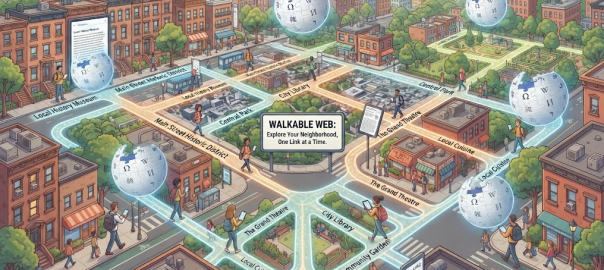
Mapping the Neighborhood: Reimagining Wikipedia as a Proximity-Based Experience

Sat Oct. 24, 2026 /Mpelembe Media/ — Local Wikipedia is an independent, unofficial web application developed by journalist, software developer, and data specialist Ed Jefferson that turns Wikipedia into a proximity-focused, ambient spatial encyclopedia. Conceived during lockdown and released in late 2026, the application operates on the core thesis of displaying geotagged Wikipedia articles located within a thirty-minute walk from the user. Users can set their location using native browser geolocation or manual text queries such as town names, landmarks, and UK postal codes. To balance visual clutter and system performance across varying geographic densities, the platform automatically adjusts its operational scope, expanding up to six miles in low-density rural areas or capping results at five hundred items in dense urban centers. Designed with client-side privacy in mind, positioning coordinates remain strictly within temporary local browser memory, and exported links are sanitized to ensure physical location data is never shared. Continue reading →

24Oct/26

How Foreign Investors Trade in Zambia

Investing in the Lusaka Securities Exchange: Comparative Pathways, Settlement Mechanics, and Treaty Tax Relief for UK Residents

Sat Oct. 24, 2026 /Mpelembe Media/ — The Lusaka Securities Exchange (LuSE) operates under the regulatory supervision of the Securities and Exchange Commission (SEC) of Zambia pursuant to the Securities Act No. 41 of 2016, providing a centralized capital market with an equity market capitalization of approximately USD 2.30 billion. To prevent off-market fragmentation, Zambian law mandates that all public companies with 50 or more shareholders must register with the SEC and trade exclusively on a recognized stock exchange, effectively prohibiting Over-The-Counter (OTC) equity markets. The exchange functions across a two-tier market structure comprising the Main Board (Official List) for established public enterprises and the Quoted Tier for growth-phase entities. Zambia maintains a fully liberalized foreign exchange regime with no exchange controls, permitting up to 100% foreign ownership in private and listed assets—with narrow statutory exceptions, such as domestic cellular network operators required to float 10% of their shares on the exchange—and guaranteeing the repatriation of investment capital, dividends, and profits through the Bank of Zambia. Continue reading →

24Oct/26

Zambia Erases Former President Edgar Lungu

Labour Activist Calls for Professionalism and National Unity Following Independence Day Controversy

Sat Oct. 24, 2026 /Mpelembe Media/ — Labour activist and salary wages advocate Trust Ngwira has questioned Permanent Secretary for Information Thabo Kawana and the Zambia Daily Mail regarding the omission of Zambia’s sixth President, Edgar Chagwa Lungu, from an Independence Day publication. Describing the incident as deeply unfortunate, Ngwira highlighted that Independence Day is a national occasion meant to symbolise love, peace, unity, and respect for the country’s history. He urged individuals in positions of responsibility to carefully weigh the consequences of their actions and statements to avoid creating unnecessary public controversy that could put Republican President Hakainde Hichilema in an embarrassing position. Continue reading →