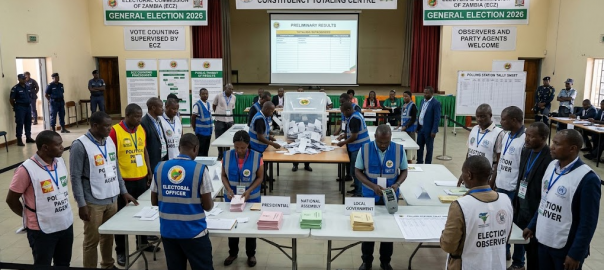

For Zambian voters, the 2026 election represents a critical choice balancing long-term macroeconomic recovery against immediate, severe household pressures. While President Hakainde Hichilema’s administration successfully restructured the nation’s default-era debt and introduced popular programs like universal free education, ordinary citizens are heavily squeezed by a high cost of living, rising food costs, and inflation exacerbated by a historic drought. A primary concern voters should watch out for is the post-election handling of the country’s structural electricity crisis. To avoid grueling 20-hour blackouts during the campaign cycle, the state utility ZESCO has relied on costly emergency regional power imports. Because this spending is fiscally unsustainable, voters face the high risk of a post-election fiscal correction, which will likely involve steep, inflation-inducing retail tariff hikes or a return to severe load-shedding. Furthermore, due to widespread grassroots dissatisfaction with local representation, there is a strong potential for split-ticket voting, meaning voters may back the incumbent president while actively rejecting sitting members of parliament and local councilors. Continue reading
Category Archives: World
How Copper Debt Poisoned Zambian Democracy
From Reform to Repression: Zambia’s Authoritarian Turn Under the Shadow of Digital Neo-Colonialism
Mon, Aug 01 2026 /Mpelembe Media/ — The abrupt cancellation of RightsCon 2026 in Lusaka, Zambia, just days before its scheduled opening in May 2026, has exposed the profound intersection of foreign coercion and domestic democratic erosion. Although the Zambian government officially claimed the postponement was to ensure alignment with “national values,” organizers and independent reports revealed that the cancellation was directly triggered by immense pressure from the Chinese Communist Party. Chinese diplomats essentially leveraged their vast economic investments in the country to demand the exclusion of Taiwanese civil society delegates and the moderation of panels critical of Beijing’s digital authoritarianism. Because the conference was slated to be held in a facility donated by the Chinese government, and coincided with negotiations over critical development grants, the Zambian state capitulated to these extraterritorial censorship demands. Continue reading
Zambia’s 2026 battle over development receipts
Sat, Aug 01 2026 /Mpelembe Media/ — The 2026 elections are unfolding within a
new governance paradigm that prioritizes decentralized development and performance-based outcomes over traditional dynastic patronage and performative rhetoric. The unprecedented expansion of the Constituency Development Fund (CDF)—which increased allocations per constituency from K1.6 million in 2021 to K40 million in 2026—has made localized, tangible development the primary test of political legitimacy. Consequently, the path to public office in 2026 will likely be determined by a candidate’s proven record of local service, effective management of public resources, and engagement in evidence-based campaign discourse, rather than relying on hereditary claims or social media influence. Continue reading
Lake Kariba and Zambia’s land rush
The Jeremiah Island Evictions
Thu, July 30 2026 /Mpelembe Media/ — This report documents and examines the ecological, social, and industrial landscape of Lake Kariba and the broader Zambian region, focusing on the tension between economic development and community welfare. One source highlights the area’s tourism and biodiversity, detailing the lake’s role as a massive man-made reservoir that supports both wildlife and hydroelectric power. In contrast, legal and technical reports address the displacement of rural populations and the necessity of protecting customary land rights through fair compensation and informed consent. Efforts to improve public health are also discussed, specifically through the creation of nutrient-dense fish-based food products to combat infant malnutrition. Finally, the sources document the importance of regulatory oversight, as evidenced by the closure of a major fish farm for violating environmental and sanitary standards. Together, these texts illustrate a complex regional effort to balance industrial growth with environmental protection and human rights. Continue reading
Fauci’s Diaries and the Federal Data Purge
Decoding the Fauci Diaries: Public Health, Private Doubts, and a Constitutional Crisis
Thu, July 30 2026 /Mpelembe Media/ — The July 2026 Senate Homeland Security and Governmental Affairs Committee hearing culminated in a bitter constitutional standoff, fundamentally driven by the recent public release of Dr. Anthony Fauci’s private, pandemic-era diaries. The 1,141-page document, retrieved from government computer servers by Health and Human Services Secretary Robert F. Kennedy Jr., provided the rhetorical foundation for the explosive congressional session. Released by Committee Chairman Rand Paul just days before the hearing, the journals were utilized to demonstrate a stark contrast between Dr. Fauci’s private thoughts and his definitive public statements regarding the COVID-19 pandemic. Analyzing the contents of these diaries reveals deep institutional fractures concerning scientific transparency, federal record-keeping, and the limits of congressional oversight. Continue reading
Record Wildfires Paralyze France and Spain
The July 2026 Western European Wildfire Crisis
Mon, July 27 2026 /Mpelembe Media/ — The extreme wildfire emergency that swept across France and Spain in July 2026 represents a historic escalation of climate-driven natural disasters in Western Europe, displacing nearly 300,000 people in some of the largest peacetime evacuations in modern European history. Fueled by successive record-breaking heatwaves, dry vegetation, low relative humidity, and a deep hydrological drought, the concurrent megablazes overwhelmed national containment strategies and prompted massive international mobilization. Continue reading
Government Warning Signs at the Smithsonian
Executive Spatial and Jurisdictional Tactics
Fri, July 24 2026 /Mpelembe Media/ — On July 24, 2026, President Trump signed Executive Order 14415, titled “Restoring Trust in the Smithsonian Institution”. Because the Smithsonian is an independent trust governed by a Board of Regents rather than an executive branch agency, the president lacks the direct authority to fire its leadership or unilaterally alter internal displays. To bypass this structural autonomy, the administration’s strategy targets the surrounding plazas, walkways, and sidewalks outside the National Museum of American History (NMAH), which fall under the jurisdiction of the National Park Service. The executive order directs federal officials to install temporary warning signs along these approaches. Continue reading
How Empathy Became a Political Weapon
The War on Feeling: How the American Right Reframed Empathy as a Vice
Fri, July 24 2026 /Mpelembe Media/ — Modern American conservative thought has increasingly shifted toward a vocal rejection of empathy, labeling the trait as a dangerous moral failing. Prominent right-wing authors and influencers argue that prioritizing emotional understanding leads to societal decline and prevents leaders from making difficult but vital decisions. This perspective is reinforced by a surge of best-selling books that categorize compassion as a “toxic” or even “suicidal” impulse for Western civilization. High-profile figures like Elon Musk have amplified these warnings, suggesting that cultural survival depends on abandoning soft-hearted policies. This ideological trend represents a stark departure from earlier iterations of Republicanism, which once embraced the concept of compassionate conservatism. By framing empathy as a threat to the nation, contemporary right-wing media effectively distances itself from its own political history. Continue reading
Why the DOJ is Subpoenaing Reporters
Armed Agents, Family Surveillance, and Redracted Demands: Inside the DOJ’s Failed Campaign to Unmask Journalists’ Sources
Fri, July 24 2026 /Mpelembe Media/ — Recent legal developments and proposed legislation highlight a growing conflict between national security interests and press freedom in the United States. Following the rescission of Biden-era protections, the Department of Justice has adopted a more aggressive stance, exemplified by the subpoenaing of New York Times reporters to uncover anonymous sources. While the PRESS Act was introduced to establish a federal shield law and protect journalist-source confidentiality, it faced significant political opposition and failed to pass the Senate. Critics of these government actions argue that investigative authorities are being used to intimidate the media, creating a chilling effect on public interest reporting. Conversely, government officials defend these maneuvers as essential for identifying illegal leaks of classified information that could undermine national safety. Ultimately, these sources illustrate an environment where the lack of a federal shield law leaves journalists vulnerable to surveillance and prosecution during the news-gathering process. Continue reading
Your Passport Is a Geopolitical Weapon
The 20-Year Global Mobility Shift
Thu, July 23 2026 /Mpelembe Media/ — The 20-year retrospective analysis of global mobility reveals a profound geopolitical realignment, characterized by the expansion of average travel freedom alongside a starkly polarizing divide between the world’s most and least mobile populations.