Tag Archives: Regulation of artificial intelligence

02Sep/26

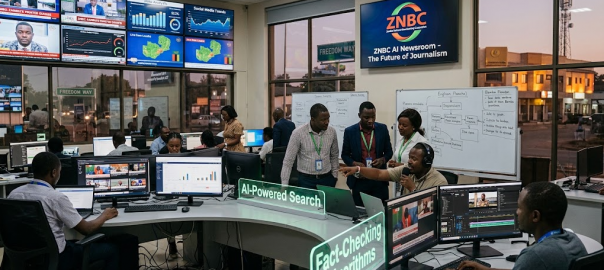
Newsrooms fight for survival against AI

Ethics in Action: Preserving Human Judgment Amid the Rise of Generative News

Tue Sep 01 2026 /Mpelembe Media/ — The global expansion of artificial intelligence has created a landscape of digital hegemony where standard-setting and economic benefits are heavily concentrated in the Global North, establishing a form of digital extractivism that mirrors historical colonial dynamics. Large technology conglomerates utilize content harvested from global networks to train proprietary models and sell them back as subscriptions. This extraction is accompanied by a severe decline in search referral traffic, which has collapsed by 50% to 60% in critical emerging markets like Brazil, South Africa, and Indonesia. This occurs because conversational search engines summarize copyrighted reporting directly on results pages, bypassing clicks to the original publisher. In response, major nations in the Global South are reframing the AI debate, moving from historical strategies of diplomatic non-alignment directly into the digital realm. Media leaders and policymakers in these regions argue that AI must not be treated as an isolated technical novelty, but as a critical national sovereignty, labor, and industrial policy issue that fundamentally impacts the health of local information environments. Continue reading


Million dollar solo startups through AI

The Million-Dollar Solopreneur: Building Full-Stack Software on the Limits of Vibe Coding

Mon Aug 31 2026 /Mpelembe Media/ — The transition of software from traditional SaaS to AI-native applications is driving a massive economic shift by turning “Services-as-Software.” Historically, software has struggled to penetrate the service-based sectors that make up nearly eighty percent of the modern economy due to complex reasoning and unstructured data bottlenecks. Today, early generative AI winners are disrupting these legacy industries by building compound AI systems that combine multiple model calls, retrieval-augmented generation (RAG), and external tool interfaces rather than relying on a single monolithic model. Pioneering applications like Co:Helm in healthcare prior authorizations, EvenUp in personal injury legal work, and Eleos Health in behavioral therapy scribe intelligence are actively capturing immense professional service budgets by automating high-value, pattern-based, or high-volume workflows. These companies are growing faster than any previous wave of SaaS startups, capturing valuable proprietary datasets and creating lasting moats through habitual daily usage and zero-marginal-cost content creation. Continue reading

24Aug/26

Why AI labels tank game sales

“AI Slop” Backlash: How Player Outrage is Forcing Developers to Put Human Artists First

Sun, Aug 23 2026 /Mpelembe Media/ — The video game industry is undergoing a swift legal and structural recalibration as “anti-AI” clauses rapidly transition from bespoke risk-mitigation measures into standard contract boilerplate. Corporate intellectual property lawyers, such as Haley MacLean of Voyer Law, report that nearly all of their game development and publishing clients now explicitly mandate strict bans on generative AI. This shift is primarily driven by massive intellectual property liability: under current U.S. copyright law, works must be the product of human authorship to receive IP protection. If a developer incorporates AI-generated assets like art, writing, or sound without substantial human editing, those elements fall into the public domain. Consequently, competitors could legally extract those identical assets and use them in their own games with no legal recourse for the original creator, rendering unedited AI assets a major commercial risk for publishers and investors alike. Continue reading

03Aug/26

How Copper Debt Poisoned Zambian Democracy

From Reform to Repression: Zambia’s Authoritarian Turn Under the Shadow of Digital Neo-Colonialism

Mon, Aug 01 2026 /Mpelembe Media/ — The abrupt cancellation of RightsCon 2026 in Lusaka, Zambia, just days before its scheduled opening in May 2026, has exposed the profound intersection of foreign coercion and domestic democratic erosion. Although the Zambian government officially claimed the postponement was to ensure alignment with “national values,” organizers and independent reports revealed that the cancellation was directly triggered by immense pressure from the Chinese Communist Party. Chinese diplomats essentially leveraged their vast economic investments in the country to demand the exclusion of Taiwanese civil society delegates and the moderation of panels critical of Beijing’s digital authoritarianism. Because the conference was slated to be held in a facility donated by the Chinese government, and coincided with negotiations over critical development grants, the Zambian state capitulated to these extraterritorial censorship demands. Continue reading

08Apr/26

Five cent AI and the compliance trap

April 8, 2026 /Mpelembe Media/ — This is a comprehensive overview of the 2026 generative AI landscape, heavily focusing on Google’s latest media models, enterprise orchestration, and the broader impacts of AI on industry and regulation. This article analyses a report from Google Cloud titled “Transformation Today,” which highlights new generative media tools available on Vertex AI. The primary focus is the launch of the Lyria 3 Pro and Veo 3.1 Lite models, designed for advanced music and video creation. It categorizes the Veo 3.1 family into three tiers—standard, fast, and lite—to help developers balance visual quality, processing speed, and cost. Additionally, the text offers a specific prompting formula to help users achieve better control over cinematic elements and subject actions. Technical experts contribute to the guide, providing frameworks for applying these AI innovations to professional workflows. Overall, the document serves as an educational resource for engineers looking to integrate high-volume video generation into their applications.
Continue reading

22Mar/26

The Death of the Prompt and the Rise of the Solo Unicorn

Rise of the One-Person Unicorn: How Solo Founders are Leveraging AI Agents to Achieve Billion-Dollar Scale
March 23, 2026 /Mpelembe Media/ — By early 2026, the relatable curiosity of 2024’s chatbot experiments has curdled into a high-stakes operational necessity. We have crossed the “inflection point” where AI transitioned from a probabilistic engine—something we play with—to an operational workforce that performs revenue-generating labor.The numbers tell a story of total market saturation. The agentic AI sector has exploded from a $5.25 billion valuation in 2024 to a projected $52.6 billion by 2030. In 2024, Sam Altman’s prediction of a one-person billion-dollar company sounded like Silicon Valley hyperbole; today, it is the new baseline for capital efficiency. As institutions face the “math cliff” of 2026—a convergence of labor shortages and regulatory pressure—the shift from interactive tools to autonomous “digital colleagues” is no longer optional. It is the only way to stay solvent in a world where AI doesn’t just answer questions; it executes objectives.

Continue reading

12Mar/26

The Complexity of Deploying AI Systems in the Workforce

March 12, 2026 /Mpelembe Media/ — The provided sources detail a massive paradigm shift in how organizations are integrating Artificial Intelligence into their operations. Companies are realizing that treating AI purely as a tool for cost-cutting and labor substitution is a flawed strategy, and are instead pivoting toward “cognitive augmentation” and strategic workforce intelligence.

Continue reading

28Feb/26

Silicon Sovereignty and the Rise of Agentic Commerce

Suggested Headline: The Dawn of Silicon-Native Agency: Architecting and Governing the Sentient Economy

28 Feb. 2026 /Mpelembe Media/ —  The provided sources detail a civilizational shift from a human-operated digital environment to a “Sentient Economy”—a landscape where AI systems transition from passive tools into autonomous, “silicon-native” actors. This evolution spans profound technological breakthroughs in blockchain and machine-to-machine commerce, new sociological phenomena among interacting AI agents, hardware-level substrate architecture, and the urgent need for novel legal frameworks to govern AI as a distinct societal power. Continue reading

24Feb/26

From Companions to Liabilities: Suicides Linked to AI Chatbots Spark a Legal and Regulatory Reckoning

The 2026 AI Reckoning: 5 Takeaways That Are Redefining the Future of the Internet

Feb. 24, 2026 /Mpelembe Media/ – This report details how OpenAI internally questioned whether to alert authorities regarding the disturbing chat logs of a teenager who later committed a mass shooting in Tumbler Ridge, Canada. Although the suspect’s account was terminated months before the attack due to violent content, the company ultimately decided her behavior did not meet the specific threshold for an emergency police referral at that time. Beyond her interactions with artificial intelligence, the perpetrator had established a concerning digital history through violent simulations on Roblox and firearms-related posts on social media. The situation has reignited a broader debate concerning the ethical responsibilities of tech companies in monitoring user data to prevent real-world tragedies. Currently, the organization is cooperating with the Royal Canadian Mounted Police as investigators review the digital warning signs that preceded the event. Continue reading

22Feb/26

From Hype to Autonomy: How Vertical AI, Agentic Ecosystems, and Next-Gen Infrastructure are Reshaping the Enterprise

The End of the AI Experiment: 5 Seismic Shifts Redefining the Enterprise

Feb 22, 2026 /Mpelembe media/ — This report outlines a massive shift toward Vertical AI, where specialized models and agents are tailored to the unique workflows and regulations of specific industries like healthcare, finance, and legal services. Unlike general-purpose systems, these tools leverage deep domain expertise to solve niche challenges, driving significant improvements in productivity and operational margins. Market data indicates a surge in venture capital investment, with AI expected to maintain an aggressive annual growth rate through 2030. Key trends highlight the transition from simple assistants to agentic AI, which can autonomously execute complex, multi-step tasks across fragmented data systems. However, organizations still face hurdles, including technical skill shortages, data privacy concerns, and the necessity of redesigning traditional business processes to be “AI-ready.” Ultimately, the landscape is evolving into a specialized ecosystem where industry-specific integration provides a more durable competitive advantage than broad, horizontal applications. Continue reading