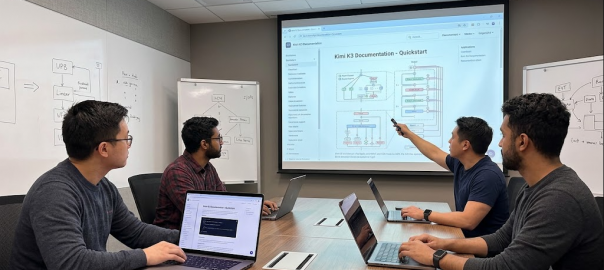

April 8, 2026 /Mpelembe Media/ — This is a comprehensive overview of the 2026 generative AI landscape, heavily focusing on Google’s latest media models, enterprise orchestration, and the broader impacts of AI on industry and regulation. This article analyses a report from Google Cloud titled “Transformation Today,” which highlights new generative media tools available on Vertex AI. The primary focus is the launch of the Lyria 3 Pro and Veo 3.1 Lite models, designed for advanced music and video creation. It categorizes the Veo 3.1 family into three tiers—standard, fast, and lite—to help developers balance visual quality, processing speed, and cost. Additionally, the text offers a specific prompting formula to help users achieve better control over cinematic elements and subject actions. Technical experts contribute to the guide, providing frameworks for applying these AI innovations to professional workflows. Overall, the document serves as an educational resource for engineers looking to integrate high-volume video generation into their applications.
Continue reading
Tag Archives: United States
Why Friction Prevents Escalation
U.S. politicians across the political spectrum have reacted with intense alarm to the President’s recent expletive-laden threats toward Iran, with several questioning his mental fitness for office.
April 6, 2026 /Mpelembe Media/ — The current conflict between the United States, Israel, and Iran began in late February 2026 with joint U.S.-Israeli “preemptive” military strikes on Iran, aiming to either eliminate the country’s nuclear capabilities or force regime change. In retaliation, Iran launched drones and ballistic missiles against Israel, as well as U.S. military targets located in the Gulf States and Jordan. Now in its sixth week, the war has severely destabilized the Middle East, killing over 3,500 people across the region—including more than 1,900 in Iran and 1,400 in Lebanon—while displacing millions. Continue reading
Never Wrestle with a Pig
April 1, 2026 /Mpelembe Media/ — Let us explore the dynamics of conflict, toxicity, and reputation management across both interpersonal relationships and macro-level societal structures.
Continue reading
NATO’s secret armies and modern hybrid warfare
Unmasking the Deep State: Cold War Subversion, the P2 Lodge, and Modern Whistleblowers
April 1, 2026 /Mpelembe Media/ — The historical sources detail the emergence of a covert “shadow government” architecture that originated during the Cold War. Initially organized by NATO, the CIA, and MI6 as clandestine “stay-behind” armies (such as Operation Gladio) to mount armed resistance in the event of a Soviet invasion, these networks frequently evolved into instruments of domestic political subversion. Across Western Europe and Turkey, right-wing paramilitary units employed a “strategy of tension,” staging false-flag terrorist attacks to spread public fear, discredit left-wing political movements, and justify authoritarian crackdowns. Prominent examples of this state-sponsored terror include the 1969 Piazza Fontana and 1980 Bologna massacres in Italy, as well as the Brabant massacres in Belgium.
Navigating the Friendship Recession and the Cost of Connection
The Decline of the “Third Place” and the Rise of Global Isolation
March 30, 2026 /Mpelembe Media/ — The Core Issue: The “Friendship Recession” Modern society is experiencing a severe decline in social capital and interpersonal connections, a phenomenon widely referred to as the “friendship recession”. Data shows a quantifiable collapse in the size of our social networks: in 1990, 33% of Americans reported having 10 or more close friends, but by 2021, that number had plummeted to just 13%. Meanwhile, the percentage of individuals reporting zero close friends has quadrupled. This erosion of social capital—the “glue” that holds communities together through networks, trust, and reciprocity—is undermining both civic engagement and personal well-being.
Shadow Governments and Hit Squads: The Weaponization of Masonic Lodges
March 28, 2026 /Mpelembe Media/ — Organized crime groups, particularly the Calabrian ‘Ndrangheta and the Sicilian Cosa Nostra, have transformed from regional racketeers into sophisticated global enterprises. Central to their modern success is the “submersion” strategy—a tactical move away from overt, bloody violence toward the silent infiltration of the legal economy, public administration, and global financial systems.
China Overtakes US in Global AI Usage
Intelligence Too Cheap to Meter: The Rise of Chinese AI Agents and the Flaws of the Token Economy
March 27, 2026 /Mpelembe Media/ — Chinese AI models have officially overtaken their US counterparts in global token consumption, marking a watershed moment in the global artificial intelligence race. This massive surge in usage is largely driven by a transition away from simple chatbots toward autonomous “agentic” workflows, which require millions of tokens to independently plan, code, and execute complex, multi-step tasks. Continue reading
The Neuroscience of Doing Nothing: How Strategic Stillness Fuels Creative Genius
March 26, 2026 /Mpelembe Media/ — The Illusion of Busyness vs. The Power of Deep Work The modern workplace is plagued by “productivity theater” or “fauxductivity,” where employees prioritize visible activity over meaningful output. Research identifies this as “Dramaturgical Work Behavior” (DWB), where workers consciously perform tasks to look busy—such as sending late-night emails or constantly rearranging files—merely to signal compliance and protect their status. This is driven by organizations that reward “passive face time” and speed rather than actual results. To combat this, experts advocate for Deep Work: distraction-free concentration that pushes cognitive capabilities to their limit and produces true value. Transitioning away from shallow, performative tasks requires setting strict boundaries, implementing a “strategic no,” and embracing “career minimalism” or “slow business” to prioritize sustainable, high-quality output over frantic activity. Continue reading
The UN Resolution on Slavery Reparations
UN General Assembly Makes History: Declares Transatlantic Slave Trade the “Gravest Crime Against Humanity”
March 27, 2026 /Mpelembe Media/ — On March 25, 2026, coinciding with the International Day of Remembrance of the Victims of Slavery and the Transatlantic Slave Trade, the United Nations General Assembly adopted a historic resolution declaring the transatlantic trafficking of enslaved Africans and racialized chattel enslavement as “the gravest crime against humanity”. Spearheaded by Ghana and heavily supported by the African Union and Caribbean Community (CARICOM), Resolution A/80/L.48 marks a significant shift in international human rights by calling for a comprehensive framework of reparatory justice.
Suing social media for addictive design
Earthquake for Big Tech: Juries Hit Meta and YouTube with Multi-Million Dollar Verdicts Over Youth Social Media Addiction
March 26, 2026 /Mpelembe Media/ — A landmark legal shift is currently unfolding as social media giants face unprecedented liability for the mental health impacts of their platforms on minors.
Landmark Jury Verdicts In a first-of-its-kind bellwether trial in Los Angeles, a jury ordered Meta and Google (YouTube) to pay $3 million in compensatory damages and recommended an additional $3 million in punitive damages to a 20-year-old woman, known in court as K.G.M. or Kaley. The jury found that both companies acted negligently and with malice, oppression, or fraud by designing platforms that addicted the plaintiff as a child, exacerbating her depression, anxiety, and body dysmorphia. Meta was assigned 70% of the responsibility for the harm, while YouTube bore 30%. TikTok and Snap, initially named as co-defendants, settled the claims against them just before the trial began. Continue reading