Tag Archives: South Africa

13Sep/26

The Struggle is One Zambia, One Nation: Kenneth Kaunda

The Political and Economic Legacy of Kenneth Kaunda: A Comprehensive Analysis

1. Introduction: The Architect of Modern Zambia

In October 1964, Kenneth Kaunda ascended to the presidency of the newly independent Republic of Zambia, executing a transition of immense strategic complexity. Navigating the metamorphosis of the former British protectorate of Northern Rhodesia into a sovereign Republic required not merely administrative acumen, but the navigation of a post-colonial state inheriting a dualistic economy characterized by enclave mineral extraction and structural dependency. Kaunda emerged as a primary architect of the region’s decolonial architecture, a role that earned him the reverential titles of “Pan-Africanist” and the “Baobab of African politics”—symbolizing a towering, resilient figure whose influence provided the essential canopy for regional liberation. His core mission, as distilled from the regional collective memory, was the reclamation of an African destiny where the continent’s inhabitants could chart their own socio-economic trajectory, finally ending the era where natural resources were plundered while the populace remained in structural poverty. This mission was predicated on a governance model that sought to harmonize indigenous values with the requirements of a modern state. Continue reading
05Sep/26

Emmanuel Mwamba from statecraft to sedition

Diplomacy, Dissidence, and Digital Resistance: The Life and Career of Emmanuel Mwamba

Sat Sep 05 2026 /Mpelembe Media/ — Emmanuel Mwamba was born on April 18, 1971, in the mining hub of Luanshya within the Copperbelt Province of Zambia. He completed his secondary education at Roan Antelope Secondary School and subsequently earned a Diploma in Journalism and Public Relations from Evelyn Hone College. He expanded his qualifications globally, obtaining a Master of Business Administration from Edith Cowan University in Australia and a Master in Peace Studies from the Institute of Peace & Security Studies at Addis Ababa University. After initial employment at the Zambia National Commercial Bank, he entered the political arena as the administrative secretary and spokesperson for Zambia’s second president, Frederick Chiluba. During this time, Mwamba aggressively defended Chiluba against state-directed corruption prosecutions. This loyalty caused friction with the administration of Levy Mwanawasa, resulting in the termination of Mwamba’s probationary contract in October 2004, though he continued serving Chiluba in a private capacity. Following the reconciliation of Chiluba and Michael Sata in 2005, Mwamba transitioned his allegiance to the Patriotic Front (PF). Continue reading

02Sep/26

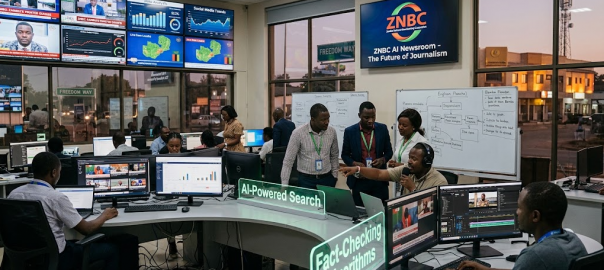
Newsrooms fight for survival against AI

Ethics in Action: Preserving Human Judgment Amid the Rise of Generative News

Tue Sep 01 2026 /Mpelembe Media/ — The global expansion of artificial intelligence has created a landscape of digital hegemony where standard-setting and economic benefits are heavily concentrated in the Global North, establishing a form of digital extractivism that mirrors historical colonial dynamics. Large technology conglomerates utilize content harvested from global networks to train proprietary models and sell them back as subscriptions. This extraction is accompanied by a severe decline in search referral traffic, which has collapsed by 50% to 60% in critical emerging markets like Brazil, South Africa, and Indonesia. This occurs because conversational search engines summarize copyrighted reporting directly on results pages, bypassing clicks to the original publisher. In response, major nations in the Global South are reframing the AI debate, moving from historical strategies of diplomatic non-alignment directly into the digital realm. Media leaders and policymakers in these regions argue that AI must not be treated as an isolated technical novelty, but as a critical national sovereignty, labor, and industrial policy issue that fundamentally impacts the health of local information environments. Continue reading

25Aug/26

Substantive Justice vs. Locked Gates: Chief Justice Malila and the Email That Shook Lusaka

The 2026 Constitutional Standoff: Bypassing Police Barricades with an Electronic Petition

Tue, Aug 25 2026 /Mpelembe Media/ — On August 24, 2026, a major constitutional crisis emerged in Zambia when state authorities physically closed the country’s superior courts—including the Supreme, High, and Constitutional Courts—citing unspecified security concerns. This unilateral administrative shutdown occurred on the final day of the strict seven-day window mandated by Article 105 of the Zambian Constitution to file a presidential petition challenging the August 13, 2026 election results. Incumbent President Hakainde Hichilema had been declared the winner with over 2.9 million votes against challenger Brian Mundubile’s 1.8 million votes. Across Lusaka and multiple provinces, court buildings were cordoned off with police tape and guarded by armed police units, physically blocking the opposition and other litigants from accessing judicial registries to file their challenges before the deadline. Continue reading

24Aug/26

Why joblessness and diamonds fuel civil war

The Dual Private Sector Dilemma: Why IMF Market-Led Growth Models Fail to Create Jobs in Fragmented African Economies

Mon, Aug 24 2026 /Mpelembe Media/ — The economic relationship between sub-Saharan Africa and the International Monetary Fund (IMF) has its roots in the 1944 Bretton Woods Conference, where the few developing nations present failed to secure explicit references to their development financing needs in the Articles of Agreement. From its inception, the IMF maintained a rigid, short-term balance-of-payments focus, famously denying Ethiopia’s first request for financial assistance on the grounds that its needs were neither immediate nor temporary. By the 1980s and 1990s, this short-term framework was formalized into neoliberal Structural Adjustment Programs (SAPs), which mandated strict conditionalities such as market deregulation, extensive privatization of state-owned enterprises, and rapid trade opening. Although promoted as pathways to long-term macroeconomic stability, these interventions frequently triggered severe adverse social consequences, including declining real wages, heightened poverty, and the systematic deterioration of basic health and social welfare systems. In response to widespread critique in the late 1990s, the IMF purported to shift its operational model, replacing traditional SAPs with the Enhanced Structural Adjustment Facility (ESAF) and, subsequently, various credit facilities under the Poverty Reduction and Growth Trust (PRGT). However, empirical evidence indicates that these contemporary programs represent “SAPs in disguise,” with loan conditionalities and stringency steadily rising, and core prescriptions of fiscal consolidation and state retrenchment remaining largely unchanged. Continue reading

23Aug/26

AI Ethics Dumping and 2Africa Cables

Countering AI Ethics Dumping: African Nations Mobilize for True Digital Autonomy

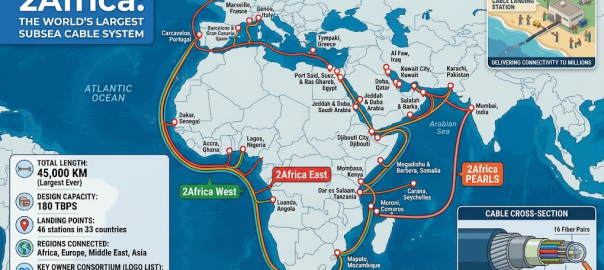
Sun, Aug 23 2026 /Mpelembe Media/ — Africa is undergoing a profound digital infrastructure revolution, shifting from historical neglect where international communications bypassed its coastlines to becoming a key hub of global data transit. This physical transformation is anchored by massive subsea cable projects driven by global technology giants. Foremost among these is Meta’s 2Africa cable system, the longest undersea telecommunications cable in the world at 45,000 kilometers, connecting 46 landing stations in 33 countries across Africa, Asia, and Europe. Boasting a design capacity of up to 180 Terabits per second, this project is expected to boost Africa’s cumulative GDP by $36.9 billion in its first few years of operation. Simultaneously, Google’s privately-funded Equiano cable runs along the western seaboard from Portugal to South South Africa, integrating space-division multiplexing to deliver 20 times the network capacity of previous regional cables. The economic impact of Equiano is massive, with projected GDP increases of $11.1 billion in Nigeria, $5.8 billion in South South Africa, and $290 million in Namibia. Continue reading

07Aug/26

From Zamrock to Internet Kill-Switches

The Rise of Zed Beats and the Digital Music Revolution

Fri , Aug 0& 2026 /Mpelembe Media/ — Zed Beats, which takes its name from the letter “Z” in Zambia, represents a dynamic hybrid music genre that emerged in the late 1980s. Young, self-taught producers began using affordable computer software to blend indigenous Zambian elements with popular global sounds like R&B, reggae, rap, hip-hop, Jamaican dancehall, Afrobeats, and amapiano. The rise of this digital movement was catalyzed by a major cultural void in the late 1980s and 1990s, when the devastating HIV/AIDS epidemic claimed the lives of a generation of veteran musicians who had anchored traditional live genres like Kalindula and Zamrock. To fill this void, which had left radio and television heavily dominated by foreign music, young enthusiasts utilized newly accessible computer technology to resurrect local music and forge a modern urban identity. Continue reading

06Aug/26

AI Automates the Industrialized Cybercrime Economy

Coordinated Policing Battles a Surge in Sophisticated, AI-Powered Scams Across Africa

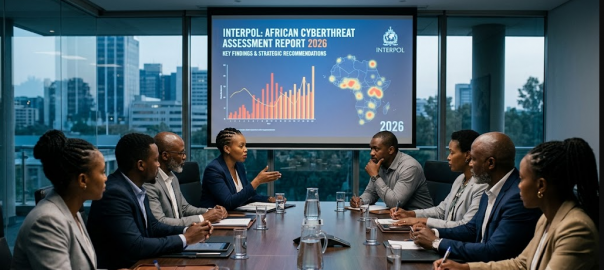
Thur , Aug 06 2026 /Mpelembe Media/ — Artificial intelligence has become the primary engine transforming cybercrime across Africa, driving 55 percent of all reported digital offenses and shifting the threat landscape from isolated incidents into an industrialized, borderless criminal ecosystem. This automation spans every stage of a cyberattack, from initial target reconnaissance and highly personalized phishing generation to execution, extortion, and operational evasion. Fueled by the continent’s rapid digital transformation, which reached over 1.1 billion registered mobile subscribers in 2025, cybercriminals have successfully scaled their operations to target massive audiences simultaneously. This has resulted in a devastating financial toll, with annual regional losses skyrocketing from $192 million in 2024 to $484 million in 2025, while the number of identified individual victims surged from 35,000 to 87,000. Continue reading

04Aug/26

Bond Rallies and Blackouts in Zambia

Zambia’s 2026 Election: A High-Stakes Two-Horse Race Decided by Economic Squeeze and Drought

Tue , Aug 04 2026 /Mpelembe Media/ — Zambia’s general election on August 13, 2026, represents a pivotal, alliance-driven contest that will test the country’s democratic resilience and economic direction. Although fourteen presidential candidates are officially cleared to run, the election is fundamentally a two-horse race between incumbent President Hakainde Hichilema of the United Party for National Development (UPND) and opposition challenger Brian Mundubile. Hichilema enters the race backed by an expanded 15-party UPND Alliance, leveraging the power of incumbency. His challenger, Mundubile—a 55-year-old lawyer, accountant, and former government chief whip—is running under the National Reconciliation Party for Unity and Prosperity (NRPUP) banner after unifying a highly fractured opposition under the Tonse–Pamodzi Alliance. Continue reading

03Aug/26

The Memoir of Dr. Kenneth Kaunda

A Wake-Up Call for the Diaspora and Economic Sovereignty Institutionalizing Peace:

Mon, Aug 03 2026 /Mpelembe Media/ — The provided sources collectively chronicle Africa’s historical journey from colonial subjugation toward liberation, heavily emphasizing the enduring spirit of Pan-Africanism. A central figure in this narrative is Dr. Kenneth Kaunda, the first president of Zambia, who led his nation to independence in 1964 and became a patriarch of the continent’s anti-colonial struggles. Through his philosophical framework of Zambian Humanism and the unifying national slogan “One Zambia, One Nation,” Kaunda sought to build a cohesive, multi-ethnic society free from the exploitation of man by man. Internationally, he—alongside contemporaries like Julius Nyerere and Kwame Nkrumah—offered crucial support to regional liberation movements fighting against apartheid and minority rule in Southern Africa. While Kaunda’s legacy involves complex debates regarding his period of one-party rule and post-colonial economic challenges, his published works, such as the seminal 1962 autobiography “Zambia Shall Be Free,” remain foundational texts that articulate the ethical and political defense of African self-determination. Continue reading