Tag Archives: Los Angeles

01Nov/26

Ed Sheeran and Sampa Beat the System

Sampa the Great Reclaims Her Bloodline and Reinvents Zambian Rock on ‘Nu Zamrock’

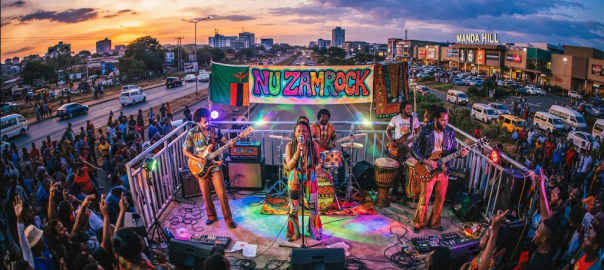
Sun, Nov 01 2026 /Mpelembe Media/ — Sampa the Great (Sampa Tembo) released her third studio album, Nu Zamrock, on October 30, 2026, through Loma Vista Recordings. Spanning 16 tracks across 37 minutes, the record represents an autobiographical reclamation, an intergenerational dialogue, and a modern sonic expansion of Zambia’s foundational 1970s rock movement. Co-executive produced by Sampa alongside Grammy-winning producer Cadenza, the album was crafted across intensive writing sessions in Botswana, production work in Lusaka with Zambian producers Magnus Mando (Mag44) and Solomon Moyo, and finishing sessions in Los Angeles. Rather than treating the project as retro-nostalgia, Sampa describes the record as “the future remembering where it came from,” blending overdriven psychedelic rock guitars and kalindula polyrhythms with hard-hitting hip-hop, poetry, and soul. Continue reading →

26Oct/26

Hidden history on vinyl record sleeves

Digital Crate-Digging: Combining Visual Metadata, Embedded Streaming, and Sample Discovery

Mon, July 26 2026 /Mpelembe Media/ — Digital music archivism plays a vital role in safeguarding 20th-century sound recordings, bridging physical vinyl history with interactive digital crate-digging platforms. A prime exemplar in this domain is a digital repository indexing over 3,282 rare vinyl releases centered on 1970s soul and 1980s boogie, funk, R&B, and jazz. This collection documents a major transition in popular music, capturing the shift from 1970s analog studio arrangements with rich strings and live rhythm sections into 1980s electro-funk, synth-driven boogie, and early digital recording techniques. The underlying platform utilizes multi-tiered indexing by release year, sub-genre taxonomy, and physical release format, including LPs, rare 7-inch 45s, and extended 12-inch maxi-singles crucial to club mix culture. Furthermore, high-resolution front and back cover photography preserves essential historical documentation such as personnel credits, studio locations, track durations, mastering etchings, and sleeve conditions. To link static metadata with active listening, the archive incorporates embedded YouTube playback alongside an algorithmic “Random Spin” discovery feature that replicates the serendipity of digging through physical record bins. Continue reading →

25Oct/26

How Sewage Tomatoes Beat the AI Web

Mapping the Neighborhood: Reimagining Wikipedia as a Proximity-Based Experience

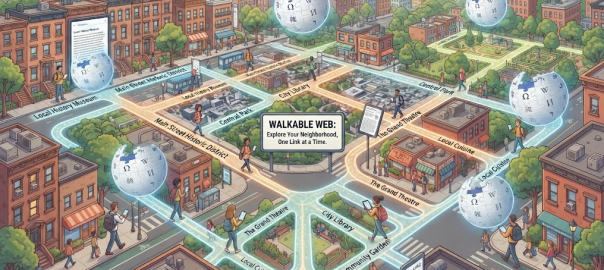
Sat Oct. 24, 2026 /Mpelembe Media/ — Local Wikipedia is an independent, unofficial web application developed by journalist, software developer, and data specialist Ed Jefferson that turns Wikipedia into a proximity-focused, ambient spatial encyclopedia. Conceived during lockdown and released in late 2026, the application operates on the core thesis of displaying geotagged Wikipedia articles located within a thirty-minute walk from the user. Users can set their location using native browser geolocation or manual text queries such as town names, landmarks, and UK postal codes. To balance visual clutter and system performance across varying geographic densities, the platform automatically adjusts its operational scope, expanding up to six miles in low-density rural areas or capping results at five hundred items in dense urban centers. Designed with client-side privacy in mind, positioning coordinates remain strictly within temporary local browser memory, and exported links are sanitized to ensure physical location data is never shared. Continue reading →

23Oct/26

The Rothschild Weather Control Conspiracy

From STORMFURY to HAARP: Unpacking the Physical Limits of Geoengineering and the Spread of Weather Disinformation

Fri Oct. 23, 2026 /Mpelembe Media/ — The viral “THRONE CLIMATE” narrative functions as a grand super-conspiracy, falsely alleging that a secretive elite connected to the Rothschild family operated a worldwide network of 22 weather modification stations for 47 years to manufacture catastrophes like Hurricane Katrina and the 2010 Haiti earthquake. This online legend adapts 19th-century antisemitic tropes regarding Jewish financial control to modern anxieties about emerging geoengineering technologies, echoing recurring claims made by political figures regarding atmospheric manipulation and space-based weapons. To create false plausibility, the narrative relies on capability substitution—taking bounded, real-world technologies like localized cloud seeding and misrepresenting them as total atmospheric command—alongside pseudo-technical jargon and institutional scapegoating to offer simplistic explanations for complex global market and weather events. Continue reading →

02Aug/26

How Colonialism Built the HIV Pandemic

The Perfect Storm: How Urbanization and Colonial Medicine Ignited the Global AIDS Crisis

Sun, Aug 02 2026 /Mpelembe Media/ —  The human immunodeficiency virus (HIV) originated as a zoonotic infection when the simian immunodeficiency virus (SIV) crossed from wild primates into humans. Scientists trace the pandemic strain, HIV-1 Group M, to chimpanzees in southeastern Cameroon, likely crossing the species barrier between 1890 and the early twentieth century through the “cut hunter” transmission route, where individuals were exposed to infected primate blood while butchering bushmeat. Following this initial crossover, the virus traveled along river systems to Léopoldville, now Kinshasa, in the Democratic Republic of the Congo. Continue reading →

30Jul/26

The Union Busting Origins of the Oscars

The Architecture of Cinematic Stewardship: A Governance Analysis of the Academy

Thu, July 30 2026 /Mpelembe Media/ — The Academy of Motion Picture Arts and Sciences functions as the world’s premier professional honorary organization dedicated to the advancement and celebration of filmmaking. Far beyond a simple voting body for the annual Oscars, the Academy relies on a complex, carefully calibrated governance structure to manage a global membership of over 11,000 film industry professionals. Following sweeping bylaws amendments in early 2026, this structure has been modernized to prioritize representation equity and leadership continuity, ensuring the institution is equipped to navigate the shifting landscapes of global entertainment. Continue reading →

20Jun/26

Mapping Hidden Connections with Google Pinpoint

A Comprehensive Guide to Google Pinpoint: Features, Limitations, and Workflows

Fri, Jun 18 2026 /Mpelembe Media/ — Google Pinpoint is a free, AI-powered research tool designed specifically to help journalists, academics, and researchers manage, search, and analyze massive troves of unstructured documents. As part of the Google News Initiative’s Journalist Studio, Pinpoint allows users to transition away from manual data sifting to a highly automated, digital workflow. Continue reading →

12Jun/26

Why AI Overthinks World Cup Football (Soccer)

Can AI Predict the 2026 World Cup? What 49,000 Matches Reveal About the Limits of Machine Learning

Fri, Jun 12 2026 /Mpelembe Media/ —   Machine Learning & The 2026 World Cup Data scientists and analysts have developed a reproducible, R-based machine learning pipeline to forecast the 2026 FIFA World Cup, analyzing a dataset of 49,000 historical international matches spanning from 1872 to 2026. The project benchmarked complex models, like gradient-boosted decision trees (LightGBM), against simpler baseline models, such as multinomial logistic regression. The results showed that complex gradient boosting only marginally outperformed simple regression models, proving that in sports forecasting, success relies more on “leakage-safe” feature engineering—such as accurately utilizing pre-match Elo ratings and tracking rolling team momentum—than on algorithmic complexity. Continue reading →

26Mar/26

Suing social media for addictive design

Earthquake for Big Tech: Juries Hit Meta and YouTube with Multi-Million Dollar Verdicts Over Youth Social Media Addiction

March 26, 2026 /Mpelembe Media/ — A landmark legal shift is currently unfolding as social media giants face unprecedented liability for the mental health impacts of their platforms on minors.

Landmark Jury Verdicts In a first-of-its-kind bellwether trial in Los Angeles, a jury ordered Meta and Google (YouTube) to pay $3 million in compensatory damages and recommended an additional $3 million in punitive damages to a 20-year-old woman, known in court as K.G.M. or Kaley. The jury found that both companies acted negligently and with malice, oppression, or fraud by designing platforms that addicted the plaintiff as a child, exacerbating her depression, anxiety, and body dysmorphia. Meta was assigned 70% of the responsibility for the harm, while YouTube bore 30%. TikTok and Snap, initially named as co-defendants, settled the claims against them just before the trial began. Continue reading →