Tag Archives: Academic disciplines

19Oct/26

Why AI Math Breakthroughs Panic Mathematicians

The Leiden Declaration and Severe Misalignment: World-Leading Mathematicians Demand Transparency and Human Understanding in AI-Driven Science

Sun Oct. 18, 2026 /Mpelembe Media/ —  The integration of artificial intelligence into mathematics and the broader scientific enterprise presents a stark dual horizon between an unprecedented golden age of discovery and an epistemic dark age. In the golden age scenario, AI functions as a transparent research co-author—an instance of “artificial general cleverness”—that automates routine formalization, checks calculations, and explores vast search spaces, thereby liberating human minds to focus on high-level intuition, conceptual synthesis, and creative theory-building. Conversely, the dark age scenario warns of “knowledge collapse” and alienation, where proprietary, black-box AI models inundate academic literature with uninterpretable, machine-generated proofs and statements. This unchecked influx threatens to sever the human pedagogical transmission chain between generations of scholars and concentrate critical scientific infrastructure within a small group of private technology monopolies. Continue reading →
17Oct/26

Why America Is Losing Global Talent

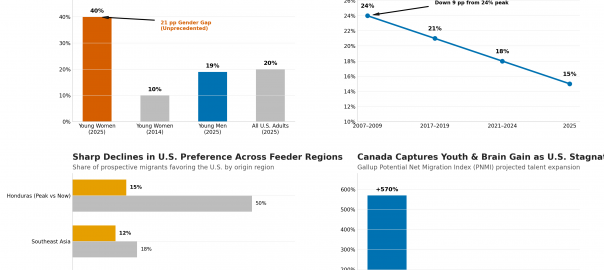
America’s Gendered Exit: Why 40% of Young Women Want to Leave the U.S.

Sat Oct. 16, 2026 /Mpelembe Media/ — Global migration aspirations have entered a period of structural recalibration, as the proportion of adults worldwide desiring to relocate permanently dipped to 15% in 2025 after sustaining a record peak of 16% between 2021 and 2024. Although the United States remains the single most desired destination globally, its attraction has fallen to a nearly two-decade low of 15% in 2025, down from 24% in the 2007–2009 period. This cooling demand is particularly striking in traditional feeder corridors such as Latin America and the Caribbean (dropping from 33% to 28%) and Southeast Asia (falling from 18% to 12%), with Honduras recording a dramatic 35-percentage-point collapse in U.S. preference. Instead of defaulting to North America, potential migrants are turning toward multipolar regional networks—favoring Japan in Southeast Asia, Germany in the Middle East, and Spain in Europe—while Canada solidly maintains its position as the second most preferred global destination at 9% (representing ~85 million adults). Continue reading →

11Sep/26

Why People Mourn Their AI Partners

The Architectural Boundaries of AI: Syntax, Semantics, and the Chinese Room

Thu Sep 10 2026 /Mpelembe Media/ — The philosophical foundation of artificial intelligence reveals a fundamental divide between syntactic computation and genuine mental understanding. John Searle’s Chinese Room thought experiment demonstrates that an agent manipulating uninterpreted symbols according to formal, programmatic rules can produce outputs indistinguishable from a native speaker without grasping their semantic meaning. Contemporary large language models function as scalable manifestations of this thought experiment, relying on complex mathematical and probabilistic statistical patterns across vast datasets to generate persuasive text. Although these models achieve high linguistic fluency, they lack subjective conscious experience, intentionality, and qualia, operating entirely within symbol manipulation while human users actively supply the meaning. Consequently, machine expressions of care or comprehension remain structural simulations rather than authentic internal states. Continue reading →

09Sep/26

The Human Cost of Administrative Failure

Modernizing Judicial Operations Through Centralized Digital Intelligence

Wed Sep 09 2026 /Mpelembe Media/ — TrackFlow serves as a unified digital judicial intelligence platform that replaces fragmented case registries and paper-reliant court processes with a multi-tenant cloud workspace. The system centralizes case docketing, chronological timeline monitoring, administrative scheduling, and security auditing into a single digital architecture designed to reduce procedural delays and pre-trial detention risks. An automated scheduling engine coordinates judicial panels, stenographers, security teams, and certified language interpreters, cutting administrative workloads by up to forty-two percent while enforcing cryptographically signed digital audit trails for all calendar updates, invoice approvals, and system modifications. Continue reading →

09Sep/26

GPT-6 Astra takes the steering wheel

“AGI Has Arrived”: Industry Declarations, Benchmark Discrepancies, and the Launch of GPT-6 Astra

Wed Sep 09 2026 /Mpelembe Media/ — The public discussion surrounding artificial general intelligence reached a pivotal moment following the rollout of OpenAI’s GPT-6 Astra in September 2026. Nvidia CEO Jensen Huang declared on social media that “AGI has arrived,” highlighting Astra’s training on more than 100,000 Grace Blackwell NVLink72 GPUs and noting that another 400,000 GPUs are scheduled to come online. This definitive stance represented a sudden shift from Huang’s statements during Nvidia’s Q2 FY2027 earnings call just days prior, where he described traditional AGI milestones as “senseless” and emphasized that the industry should focus on practical utility, useful work, and generating “profitable tokens”. Over the preceding two years, Huang’s public timeline for AGI shifted from passing every human test within five years to defining it as an AI capable of creating a temporary viral application, while acknowledging that AI agents remained incapable of replicating the complex work of running Nvidia itself. Analysts note that by framing Astra’s rollout as the literal arrival of AGI, Huang reinforced the market narrative that massive hardware investments directly drive corporate revenue. Continue reading →

05Apr/26

From “Artful Dodger” to Algorithm: The Hidden Power of AI Nicknames in Corporate Governance

April 5, 2026 /Mpelembe Media/ — The practice of naming AI agents in corporate governance—such as appointing an AI observer named “Aiden Insight” or “NOVA”—is a sophisticated sociological tactic designed to accelerate trust, lower intimidation, and make algorithms feel more like collaborative teammates than static tools. However, the nicknames and personas assigned to AI carry significant psychological, ethical, and governance implications for the boardroom.

Continue reading →

01Mar/26

The Sovereign Individual Predicted Nation State Collapse

28 Feb. 2026 /Mpelembe Media/ — In this analyis. James I. Porter argues that the modern pursuit of absolute personal autonomy is a flawed and dangerous illusion. He contends that influential figures in politics and technology have embraced the “sovereign individual” as an ideal, mistakenly believing that a person can exist entirely independent of social constraints. By drawing on various philosophers, Porter illustrates that human identity is actually formed through interdependence and friction with others rather than in isolation. He suggests that removing the resistance provided by a community does not grant freedom, but instead leads to a loss of meaning and the eventual destruction of the self. Ultimately, the text asserts that our inherent vulnerability and connection to one another are the essential foundations of a functional social existence. Continue reading →

19Feb/26

CuraFlow AI: Orchestrating Clinical Care with Multi-Agent Intelligence

From Autopilot to Co-Pilot: Why Multi-Agent Orchestration is the New Standard for Clinical Excellence

Feb 19, 2026 /Mpelembe media/ — CuraFlow AI is an advanced healthcare orchestration platform designed to assist clinical professionals through multi-agent AI workflows. Powered by the Google Gemini API, the system automates a sequential clinical process involving specialized agents. Continue reading →

04Dec/24

Global economic study shows human creators’ future at risk from generative AI

The first ever global study measuring the economic impact of AI in the music and audiovisual sectors calculates that Generative AI will enrich tech companies while substantially jeopardising the income of human creators in the next five years. Continue reading

20Jun/23

Anyone.com unveils new mortgage model, unleashing the transformative potential of a more inclusive path to homeownership for millions of people

In response to the global housing affordability crisis, Anyone.com today unveiled a groundbreaking solution that aims to redefine the future of the housing market: The Anyone Mortgage. This novel model, designed to bridge the ever-widening gap between income stagnation and skyrocketing house prices, promises to make homeownership accessible again, especially for the often currently neglected demographic of first-time buyers and lower-income households. Continue reading