

Tag Archives: Financial technology

03Sep/26

The Pulse of the Silicon Boardroom: Lord Silicon and machine settled finance

Docker, Databases, and Lord Silicon: How the 2026 Sandbox is Programmed

Thu Sep 03 2026 /Mpelembe Media/ — The Asynchronous Backend Engine The backend execution of the AI Apprentice simulation is powered by FastAPI, an asynchronous framework selected specifically for its minimal latency and exceptional high-performance routing capabilities. This asynchronous environment is crucial because it allows the system to concurrently run autonomous trading agent routines without bottlenecks. These agents, possessing distinct financial personalities, depend on the backend’s speed to execute real on-chain transactions—such as flipping digital collectibles or domains—within the competitive 24-hour sandbox. Continue reading
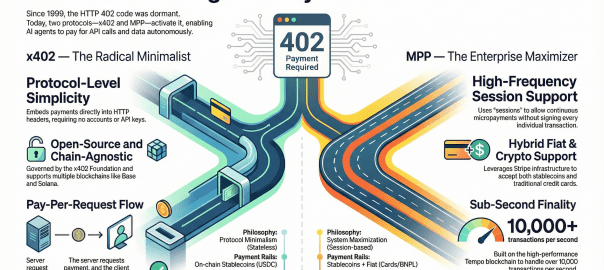

How AI agents spend real money

Mon Aug 31 2026 /Mpelembe Media/ — Stripe has positioned itself as the economic infrastructure layer for the artificial intelligence era, building a comprehensive suite of products designed to handle both the expense and income sides of autonomous agent commerce.

Rather than forcing developers to choose strictly between crypto-native or legacy card networks, Stripe bridges both systems. The core of Stripe’s production-ready agentic framework operates across several key pillars: Continue reading

21Aug/26

The hidden plumbing of AI commerce

From Payments to Intelligence: Inside Stripe’s Bold Move to Own the AI Token Economy

Fri, Aug 21 2026 /Mpelembe Media/ — Stripe has officially agreed to acquire OpenRouter, a premier AI model marketplace and gateway, in a landmark transaction that positions the fintech giant at the center of the fast-growing token routing sector. While the companies did not publicly disclose the purchase price, multiple reports value the deal at approximately $7.5 billion, representing a massive premium over the startup’s $1.3 billion private valuation set just months earlier. Under the reported terms of the agreement, $1.5 billion will be distributed to OpenRouter’s founders and key staff, with the remaining $6 billion going to its venture capital and seed-stage investors. OpenRouter, which facilitates access to over 400 AI models and handles more than 10 trillion tokens daily for over 10 million developers, will continue to operate under its existing brand, name, and product roadmap. Through this acquisition, Stripe aims to help enterprise clients dynamically evaluate and route requests to the most cost-efficient models in real time, turning the management of volatile AI token costs into a core part of its programmable financial services platform. Continue reading

29Jul/26

Zambia’s massive leap into digital finance

Navigating Zambia’s Digital Payment Landscape

Wed, July 29 2026 /Mpelembe Media/ — The Zambian digital payment ecosystem historically struggled with severe fragmentation, relying heavily on bilateral agreements between financial institutions and routing domestic card transactions through expensive international networks. To address these structural inefficiencies and lower the cost of domestic electronic payments, the Bank of Zambia, the Bankers Association of Zambia, and the Zambia Electronic Clearing House Limited initiated the National Financial Switch project in 2013. The system was designed as a shared public utility to interconnect various payment streams, including automated teller machines, point-of-sale systems, and mobile money platforms, thereby eliminating the need for institutions to build and maintain costly bilateral connections. Continue reading

29Jul/26

Why Zambia’s Digital Rails Need Routine

Zambia’s Digital Payment Landscape: Bridging the Gap from Rails to Routine

Wed, July 29 2026 /Mpelembe Media/ — Zambia has made remarkable strides in expanding financial access, achieving a financial inclusion rate of 80.1% by 2025, a significant increase from 69.4% in 2020. A cornerstone of this progress is the National Financial Switch (NFS), a shared infrastructure that connects banks, payment service providers, fintechs, and mobile money operators. By facilitating wallet-to-bank, bank-to-wallet, and merchant transactions, the NFS eliminates the need for institutions to build expensive bilateral connections. However, despite these foundational achievements, Zambia faces a critical new challenge: transitioning these digital “rails” into an affordable, trusted, and everyday routine for its citizens. Continue reading

07Mar/26

MetaMask’s 2026 Evolution: The Ultimate Web3 Gateway for Crypto, Trading, and Real-World Spending

More Than a Wallet: 5 Surprising Ways MetaMask is Redefining Your Digital Life

March 7, 2026 /Mpelembe Media/ — These sources provide a comprehensive overview of the MetaMask and Solana wallet ecosystems as of 2026, focusing on user security, functionality, and rewards. The documentation emphasizes the critical importance of protecting Secret Recovery Phrases and managing token approvals to defend against evolving AI-powered scams and phishing threats. Recent updates highlight the expansion of the MetaMask Card across the United States and the introduction of Season 1 Rewards, which incentivizes on-chain activity through a points-based system. Technical advancements such as MetaMask Snaps are also detailed, showing how users can now access non-EVM networks like Solana and StarkNet from a single interface. Additionally, the guides compare popular hot wallets like Solflare and Phantom against cold storage solutions like Ledger and the Solflare Shield. By integrating hardware wallets with mobile applications, these platforms aim to balance everyday usability with the robust protection required for long-term digital asset management. Continue reading

01Mar/26

The Sovereign Individual Predicted Nation State Collapse

28 Feb. 2026 /Mpelembe Media/ — In this analyis. James I. Porter argues that the modern pursuit of absolute personal autonomy is a flawed and dangerous illusion. He contends that influential figures in politics and technology have embraced the “sovereign individual” as an ideal, mistakenly believing that a person can exist entirely independent of social constraints. By drawing on various philosophers, Porter illustrates that human identity is actually formed through interdependence and friction with others rather than in isolation. He suggests that removing the resistance provided by a community does not grant freedom, but instead leads to a loss of meaning and the eventual destruction of the self. Ultimately, the text asserts that our inherent vulnerability and connection to one another are the essential foundations of a functional social existence. Continue reading

28Feb/26

Beyond the Hype: 7 Hard Truths About Securing the Modern Decentralized Stack

The 2026 Crypto Compliance Mandate: Navigating MiCA and the End of the Grandfathering Era

28 Feb. 2026 /Mpelembe Media/ —  The July 2026 Deadline and “Passporting” The European Union is fundamentally restructuring its digital asset market through the Markets in Crypto-Assets Regulation (MiCA). By July 1, 2026, the transitional “grandfathering” phase will permanently close, meaning any Crypto-Asset Service Provider (CASP) operating without full MiCA authorization will be doing so illegally. While some member states, like the Netherlands and Sweden, opted for much shorter transition periods that have already expired, the July 2026 date is the absolute maximum limit across the EU. Securing this license grants firms EU-wide “passporting” rights, allowing them to serve clients across all 27 member states with a single authorization. Continue reading

09Feb/26

The Rise of the Autonomous Economy: AI Agents and Blockchain Converge to Redefine Finance in 2026

10 Feb. 2026 /Mpelembe Media  — Ripple will unveil its 2026 Roadmap on February 11, focusing on integrating XRP into capital markets. Key updates include smart contracts, zero-knowledge proofs for privacy, and cross-chain liquidity. These advancements aim to drive institutional adoption and utility. Continue reading

21Nov/25

Is AI eating Crypto’s Lunch?

Nov. 21, 2025 /Mpelembe Media/ — That phrase, “AI is eating crypto’s lunch,” generally refers to the current trend where Artificial Intelligence (AI) development and related companies are attracting significantly more investor capital and attention than the cryptocurrency and blockchain sectors.

However, the reality is more nuanced than a zero-sum competition, and both areas are also seeing convergence. Continue reading