Tag Archives: Saudi Arabia

01Nov/26

The Illusion of Democracy: Constitutional Manipulation and the Modern Dictator

How Modern Dictators Hold Absolute Power

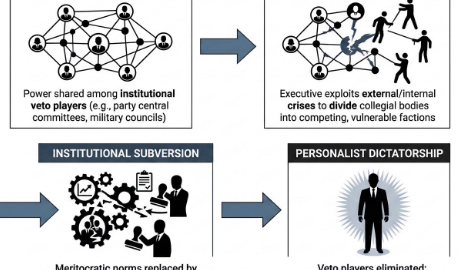
Sun, Nov 01 2026 /Mpelembe Media/ —A dictatorship is a system of governance where a single individual or political party wields absolute power, typically emerging during periods of severe social unrest or economic instability. Within these regimes, personal autonomy, political choice, and human rights are heavily suppressed, and democratic institutions as well as opposition parties are dismantled. Rulers maintain authority through coercion, intimidation, unlawful imprisonment, violence, and state apparatuses such as secret police or indefinite detentions. Furthermore, autocrats frequently manipulate legal frameworks to preserve control; for instance, constitutional amendments in Russia altered presidential term limits to allow Vladimir Putin to remain in power through 2036. While autocracies concentrate unchecked authority strictly within an individual—a category that historically encompassed benevolent rulers—dictatorships can disperse authority across a governing party or ruling circle and inherently feature severe abuses of power. Continue reading →

25Oct/26

Where Foreign Influence Becomes Illegal

Allegations, Cyber Surveillance, and Denials: The Conflict Over Jared Kushner’s Middle East Financial Dealings

Sat Oct. 24, 2026 /Mpelembe Media/ — An excerpt published by Vanity Fair from journalist Matthew Cole’s book Princes and Thieves alleges that former White House senior adviser Jared Kushner had access to undisclosed foreign bank accounts holding up to $2 billion supplied by Gulf leaders during Donald Trump’s first presidential administration. According to these claims, Dutch military intelligence (MIVD) intercepted Kushner’s personal smartphone activity starting in 2018 after discovering device screenshots stored on a Russian military intelligence (GRU) server in Rostov. Spies reportedly observed Kushner accessing Account Alpha at First Abu Dhabi Bank—which contained roughly $750 million under the cover of an Emirati charitable foundation with funds routed via Azerbaijani banks—as well as Account Beta, an estimated $1 billion repository at the Bank of Israel reportedly subject to transaction oversight by Israeli Prime Minister Benjamin Netanyahu. Continue reading →

23Oct/26

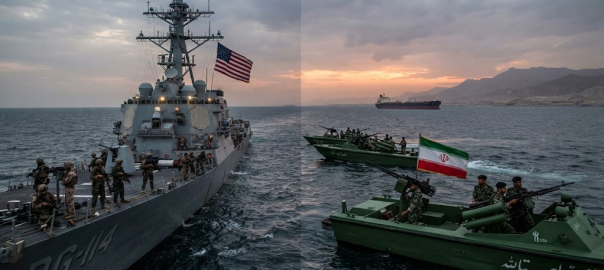
How Failed US-Iran Talks Triggered War

Losing the Coalition: How Domestic Immigration Raids and Foreign Conflicts Alienated Key Voters

Fri Oct. 23, 2026 /Mpelembe Media/ — The Republican Party faces an intensifying political and governance crisis heading into the November 3, 2026 midterm elections, driven by President Donald Trump’s career-low approval ratings between 32% and 35%. Broad public disapproval stems from an unfulfilled campaign promise to avoid endless foreign conflicts and lower consumer prices. Instead, the ongoing war with Iran—now in its seventh month despite initial predictions of a four-to-five-week duration—has combined with a persistent domestic affordability crisis to severely weaken GOP majorities in Congress. Continue reading →

17Oct/26

Why America Is Losing Global Talent

America’s Gendered Exit: Why 40% of Young Women Want to Leave the U.S.

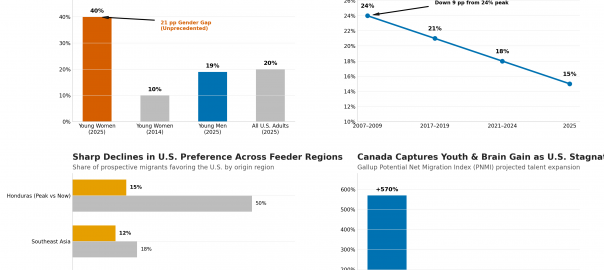
Sat Oct. 16, 2026 /Mpelembe Media/ — Global migration aspirations have entered a period of structural recalibration, as the proportion of adults worldwide desiring to relocate permanently dipped to 15% in 2025 after sustaining a record peak of 16% between 2021 and 2024. Although the United States remains the single most desired destination globally, its attraction has fallen to a nearly two-decade low of 15% in 2025, down from 24% in the 2007–2009 period. This cooling demand is particularly striking in traditional feeder corridors such as Latin America and the Caribbean (dropping from 33% to 28%) and Southeast Asia (falling from 18% to 12%), with Honduras recording a dramatic 35-percentage-point collapse in U.S. preference. Instead of defaulting to North America, potential migrants are turning toward multipolar regional networks—favoring Japan in Southeast Asia, Germany in the Middle East, and Spain in Europe—while Canada solidly maintains its position as the second most preferred global destination at 9% (representing ~85 million adults). Continue reading →

09Apr/26

Leading Global Teams with Cultural Intelligence

Managing the World’s Biggest Tournament: A Guide to the Absurdities of ‘Twenty Twenty Six’

April 9, 2026 /Mpelembe Media/ —  Twenty Twenty Six is a six-part mockumentary comedy series created by John Morton, serving as a spiritual sequel to his previous comedies Twenty Twelve and W1A. The series follows the return of the amiably vexed Ian Fletcher (Hugh Bonneville), who takes on a new role as the incoming director of integrity and head of the oversight team for the world’s largest football tournament. Due to legal reasons, the words “Fifa” and “Cup” are bleeped out throughout the show.

Continue reading →

08Apr/26

The Fragile 2026 Iran War Ceasefire

Global Markets Rally as U.S. Halts Operation Epic Fury for Islamabad Negotiations

April 8, 2026 /Mpelembe Media/ — The 2026 war in the Middle East has reached a critical diplomatic turning point following a provisional two-week ceasefire between the United States and Iran, agreed upon on April 7, 2026. The truce, brokered through the mediation of Pakistani officials, was reached less than two hours before President Donald Trump’s deadline to launch devastating strikes against Iranian power plants and bridges. Prior to the agreement, Trump had escalated his rhetoric to unprecedented levels, warning that “a whole civilization will die” if Iran did not reopen the vital Strait of Hormuz to global shipping.

Continue reading →

10Mar/26

How Operation Epic Fury Fractured Iran

The “Epic Fury” Fallout: 6 Takeaways That Are Redefining the Middle East

10 Feb. 2026 /Mpelembe Media/ —  These reports detail a 2026 military escalation involving coordinated U.S. and Israeli air strikes against Iran under the Trump administration. Operation “Epic Fury” resulted in the death of Supreme Leader Ali Khamenei and the destruction of significant nuclear and missile infrastructure, prompting Iranian retaliation against Israel and Gulf states. Experts describe the American strategy as maximalist but improvised, noting a lack of clear plans for regime change or post-war governance. The conflict has triggered global economic anxiety due to potential disruptions in the Strait of Hormuz and surging energy prices. Regional security is further complicated by Hezbollah’s involvement in Lebanon and the selection of Mojtaba Khamenei as Iran’s new hardline leader. Ultimately, the sources highlight a strategic dilemma for Washington: balancing the desire for a decisive victory against the risk of an endless regional war. Continue reading →

07Mar/26

How is the U.S.-Israel-Iran conflict reshaping the global economy?

March 7, 2026 /Mpelembe Media/ — Geopolitical Risk Report: The 2026 West Asian Realignment and the Collapse of Regional Diplomacy

The U.S.-Israel-Iran conflict is triggering severe shocks across the global economy, primarily through disruptions to energy supplies, international trade routes, financial markets, and critical technology infrastructure.

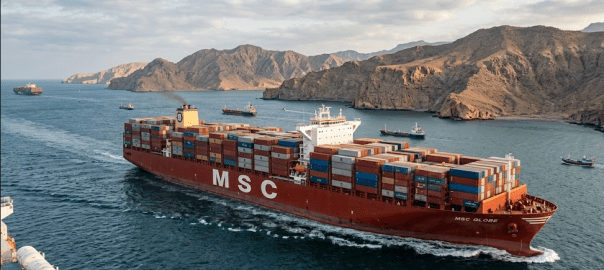
Energy Market Upheaval The most immediate economic threat stems from rising energy prices due to the disruption of the Strait of Hormuz—a crucial maritime chokepoint that normally handles about one-fifth of the world’s oil and liquefied natural gas (LNG). Following Iranian threats, commercial shipping through the strait has slowed to a near-standstill, with tanker traffic dropping by about 90% and multiple insurance firms canceling coverage for Gulf vessels. Continue reading →

02Mar/26

Global Transit in Chaos: War in Iran Triggers Massive Airspace Closures and Threatens Energy Markets

Middle East in Turmoil: US-Israeli Strikes Kill Khamenei, Triggering Iranian Retaliation and Global Transit Paralysis

March 2, 2026 /Mpelembe Media/ — On February 28, 2026, the United States and Israel launched a massive, coordinated military campaign against Iran, targeting the country’s leadership, nuclear facilities, and military infrastructure. The strikes resulted in the assassination of Supreme Leader Ali Khamenei and dozens of top Iranian military and government officials, severely degrading the regime’s command-and-control structure. Continue reading →

28Feb/26

The Board of Peace is Bombing Iran for the Gaza Riviera

5 Radical Realities Reshaping the Middle East

28 Feb. 2026 /Mpelembe Media/ —  The 2026 US-Iran War (“Operation Epic Fury”) Tensions between the United States and Iran escalated sharply in late 2025 and early 2026 following massive anti-regime protests in Iran, which the Iranian government suppressed with unprecedented lethal force and internet blackouts. In response, US President Donald Trump initiated a massive military buildup in the Middle East, deploying two aircraft carrier strike groups and issuing ultimatums demanding Iran halt its nuclear program and proxy support.
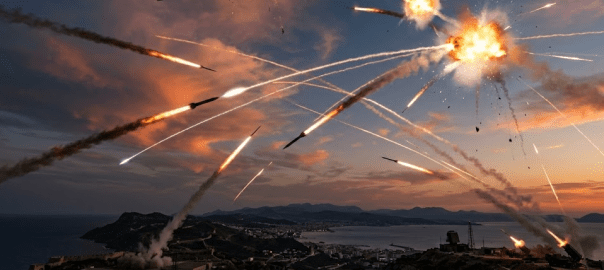
After US-brokered nuclear negotiations in Geneva broke down, the US and Israel launched joint military strikes on Iran on February 28, 2026, dubbed “Operation Epic Fury” and “Operation Roaring Lion”. The massive bombardment targeted Iranian nuclear facilities, military infrastructure, and leadership compounds in Tehran. In retaliation, Iran launched significant ballistic missile barrages at Israel and US military bases across the Persian Gulf, including in Bahrain, Qatar, Kuwait, and the UAE, while its regional proxies mobilized, triggering a multi-theater conflict.

Continue reading →