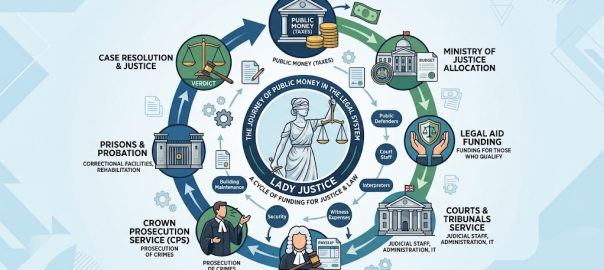
Jan. 1, 2026 /Mpelembe Media/ — In 2026, you are protected by a new generation of laws—specifically Article 86 of the EU AI Act and Article 22 of the UK/EU GDPR. These laws give you a “Right to Explanation” when a “high-risk” AI (the kind used in the AI Economy for jobs, loans, or insurance) makes a decision about you. Continue reading
Tag Archives: Artificial intelligence
Understanding the AI Economy and Digital ID
Jan. 1, 2026 /Mpelembe Media/ — The “Fifth Industrial Revolution” (5IR), is a shift from tools that we control to environments that control themselves. It frames the future not as a collection of gadgets, but as a totalizing system—the “Cathedral”—where the infrastructure itself makes moral and economic decisions. The Dark Industrial Cathedral is built on surveillance, extraction, and algorithmic control. The primary task for 5IR leaders is “engineering ethics into infrastructure” by embedding human values directly into the code. Continue reading
Beyond Automation: AI as the Operating System of Human Civilisation
Dec. 31, 2025 /Mpelembe Media/ — As of 2025, the global economy is projected to reach approximately $115 trillion, even as it faces a staggering $338 trillion in total debt. Within this landscape, artificial intelligence has emerged as the foundational infrastructure of a Fifth Industrial Revolution, with the AI economy expected to contribute over $15.7 trillion to global GDP by 2030. This technological shift is characterized by the rise of AI sovereignty, where control over data and models defines geopolitical power. While automation and AI agents enhance productivity and business valuations, they also present significant risks regarding cybersecurity and the potential erosion of human identity. Ultimately, society faces a critical choice between using these tools to foster human dignity or allowing them to create a future defined by algorithmic surveillance and control. Continue reading
Private associations and secret societies in the era of AI
Dec. 30, 2025 /Mpelembe Media/ — Private associations and “secret brotherhoods” remain highly relevant and controversial in the modern era. AI might interact with these organisations in an age of data-driven transparency and AI-led surveillance, the human-to-human, unrecorded nature of secret brotherhoods might become even more relevant as a way for individuals to maintain private influence outside of digital footprints. However, you may want to independently verify how AI specifically impacts the social standing of such groups. Continue reading
The AI Displacement Dilemma: Nearly Half of Workplace Skills Face Obsolescence by 2025
Dec. 29, 2025 /Mpelembe Media/ — This edX and Workplace Intelligence report examines how artificial intelligence is fundamentally transforming the modern professional landscape. The findings reveal a significant skill gap, as executives anticipate that nearly half of current workforce capabilities will be obsolete by 2025. While leadership believes many roles—including executive positions—could be automated, entry-level staff are particularly vulnerable to displacement. Despite a strong desire among staff to gain AI proficiency, many organisations currently lack the robust training and development frameworks necessary to support this transition. Ultimately, the research suggests that companies must prioritise internal upskilling to retain talent and remain competitive in an increasingly automated economy. Continue reading
Cybersecurity Forecast 2026: The Rise of AI Agents, Persistent Extortion, and Evolving Nation-State Tactics
Dec. 29, 2025 /Mpelembe Media/ — The Cybersecurity Forecast 2026 report by Google Cloud examines the anticipated evolution of digital threats, primarily focusing on the transformative role of artificial intelligence. It describes how adversaries will increasingly use AI agents for automated attacks and sophisticated social engineering, while defenders will adopt similar technology to enhance security operations. Beyond AI, the analysis highlights the persistent danger of ransomware and the expansion of cybercrime into the blockchain and virtualisation sectors. The document also evaluates the strategic motivations of nation-state actors from Russia, China, Iran, and North Korea as they pursue global espionage and disruption. Ultimately, the report serves as a guide for organisations to modernise their identity management and governance frameworks in response to these emerging risks. Continue reading
The Evolution of Vibe Engineering
Dec. 29, 2025 /Mpelembe Media/ — Artificial intelligence is fundamentally restructuring the software development lifecycle. Software engineering will become the primary application for AI, transitioning from simple code generation to sophisticated vibe engineering driven by natural language. This shift is expected to decrease computer science enrolment and significantly extend the time required to recruit developers as companies prioritise senior staff with AI expertise. Consequently, human roles will shift towards governance and architecture, necessitating a move toward as-code automation for nearly all enterprise development processes. To remain competitive, technology leaders are advised to modernise their hiring practices and integrate agentic development techniques immediately. Continue reading
Google Cloud Launches New Partner Network Focused on Customer Outcomes and AI-Driven Automation
Dec. 29, 2025 /Mpelembe Media/ — The Google Cloud Partner Network is a revamped initiative launching in early 2026 to transform how the company collaborates with its global partners. This new framework shifts the focus away from traditional administrative requirements toward real-world customer outcomes and measurable technical impact. The program is built upon three central pillars: simplicity, outcomes, and automation, which collectively aim to reduce manual reporting through AI-driven tracking. Significant updates include a transition to a three-tier ranking system—featuring a prestigious new Diamond tier—and a competency model that rewards deep technical expertise. Partners will have a six-month transition period to adapt to these changes, which are designed to prioritise high-quality service delivery and shared innovation. Ultimately, the network aims to foster more meaningful business results by streamlining how partner contributions are recognised and rewarded. Continue reading
AI Has Altered Entry-Level Technology Hiring
Dec. 25, 2025 /Mpelembe Media/ — Recent graduates from Stanford’s computer science programme are finding it increasingly difficult to secure employment as artificial intelligence transforms the tech industry. Research indicates a significant reduction in entry-level hiring, as companies now prefer using automated tools alongside a small number of experienced developers instead of larger teams of junior staff. This shift has led many students to extend their education in hopes of gaining a competitive edge while waiting for a more favourable market. Beyond workforce displacement, the rise of AI presents environmental challenges due to the immense electricity and water required to power massive data centres. To adapt, experts suggest that universities update their curricula and students focus on complex system design and oversight skills that automation cannot yet replicate. Industry advocates also call for government intervention through retraining programmes to support workers affected by these rapid technological changes. Continue reading
Preferred Sources in The AI Era
Dec. 25, 2025 /Mpelembe Media/ — Google is introducing new search features and global partnerships to better connect users with digital content in the artificial intelligence era. A primary update is the global rollout of Preferred Sources, which allows individuals to prioritise their favourite news outlets and websites within their search results. The company is also enhancing its AI interfaces by adding more direct links and descriptive context to help people explore the web more effectively. Additionally, Google is launching collaborative pilot programs with major international publishers to test AI-powered summaries and real-time data integration. These initiatives aim to foster deeper engagement between readers and creators while providing more personalised browsing experiences. Together, these advancements represent a significant shift in how information is discovered and consumed across the broader ecosystem. Continue reading