





17Oct/26

How an A-Level Computer Scientist Re-Engineered National Economic Strategy

Sat Oct. 16, 2026 /Mpelembe Media/ — Ing’utu Mutti Palmer: Career and Advocacy Analysis
From Python to Policy: How an A-Level Computer Scientist Re-Engineered National Economic Strategy

Why do modern policy and development frameworks so frequently stall when confronted by complex global challenges? In an increasingly interconnected world, hyper-specialization often misses the mark because systemic crises rarely exist in isolated domain silos. Solving multi-dimensional problems requires modern polymaths—leaders who can seamlessly translate computational logic, executive corporate governance, and grassroots human advocacy across international borders.British-Zambian educator, corporate director, author, and socio-economic advocate Ing’utu Mutti Palmer exemplifies this cross-disciplinary approach. Based in Leicestershire, United Kingdom, Palmer’s multi-faceted career bridges post-16 STEM education, corporate governance, published literature, and transnational policy consultation. By navigating between software engineering classrooms, private sector boardrooms, and diplomatic summits, her trajectory offers a blueprint for how computational thinking and commercial discipline can re-engineer macroeconomic strategy and civic inclusion.Here are five key takeaways from Palmer’s career that reveal how computer science, corporate governance, and global policy intersect to unlock solutions to systemic global issues. Continue reading →

17Oct/26

Chisenga – Loco feat. Joyce Tanmuoh

From Dance Mats to Club Bangers: The Evolution of Nightlife Narratives and Social Chemistry in Pop Music

Sat Oct. 16, 2026 /Mpelembe Media/ — Modern nightlife in contemporary popular music functions as a dynamic microcosm of youth culture, where crowded dance floors, late-night bars, and house parties become vibrant stages for complex emotional negotiations and romantic chemistry. Across featured tracks like Chisenga’s “Loco feat. Joyce Tanmuoh,” artists capture energetic club settings where crowded dance floors, penthouse after-parties, and complicated relationship statuses form the backdrop for unexpected romantic connections. A key narrative device identified across these works is the spectator-protagonist, an individual who balances active participation in collective party rituals with an internal observation of peer dynamics and romantic desire. Works such as Brynn Cartelli’s “Girl Code,” Olivia Rodrigo’s “bad idea right?”, and Ed Sheeran’s “Shape of You” illustrate this tension by contrasting the social safety of friend circles against the impulsive pull of immediate physical attraction, ex-partner relapses, or late-night courtship. Continue reading →

17Oct/26

Lily Mutamz Takes On the Zambian Government

From Munali to the UK Diaspora: The Evolution of Lillian Mutambo’s Transnational Advocacy

Sat Oct. 16, 2026 /Mpelembe Media/ — Lillian Mutambo’s political career began with direct community-level organizing in Zambia ahead of the 2021 General Election. After returning from the UK, she sought the UPND nomination for the Munali Constituency under the campaign slogan “Shape You Munali,” engaging in local economic empowerment initiatives such as distributing eggs to help youth and women start small businesses. Following intra-party selection disputes and friction within the UPND, Mutambo broke away to contest the seat as an Independent candidate in 2021, marking her formal entry into parliamentary politics. Continue reading →

17Oct/26

Why Couples Therapy Fails Diverse Relationships

Healing Black and Inter-Ethnoracial Partnerships: Bridging Systems Theory, Critical Race Principles, and Emotionally Focused Therapy

Sat Oct. 16, 2026 /Mpelembe Media/ — Standard evidence-based couples therapies, including Emotionally Focused Therapy (EFT), demonstrate high overall efficacy in reducing relationship distress, yet their foundational frameworks were developed almost exclusively around White, middle-class, heterosexual norms. The assumption that adult attachment principles operate universally without regard to race, power, and cultural context fails to account for how chronic exposure to structural racism, microaggressions, and systemic oppression creates cumulative racial stress that directly impairs intimate relationships. When clinicians apply unadapted Western models to African American or inter-ethnoracial couples, they risk pathologizing culturally socialized protective behaviors or misinterpreting coping strategies as individual deficits or treatment resistance. Culturally responsive therapy requires moving beyond a purely dyadic attachment lens to integrate a network-oriented, socioculturally attuned framework that explicitly acknowledges how external societal hostility intersects with internal relational dynamics. Continue reading →

17Oct/26

U.S. immigration: National Interest Waivers, and Consular Strategies for Zambian Travelers

Navigating Proclamation 10998: What the 2026 U.S. Travel Restrictions Mean for Zambian Passport Holders

Sat Oct. 16, 2026 /Mpelembe Media/ — Effective January 1, 2026, Presidential Proclamation 10998 placed Zambia into a partial suspension tier that restricts entry and visa issuance for its passport holders. Under this executive directive, Zambian nationals who were outside the United States without a valid visa on the effective date are barred from obtaining immigrant visas as well as B-1/B-2 visitor visas, F academic student visas, M vocational student visas, and J exchange visitor visas. The United States government justified Zambia’s inclusion by citing Department of Homeland Security metrics showing a 10.73 percent overstay rate for B-1/B-2 visitor visas and a 21.02 percent overstay rate for student and exchange visitor categories. For nonimmigrant visa classifications that remain open, such as employment-based H-1B, L-1, and O-1 visas, consular officers are instructed to shorten validity periods, typically limiting approved visas to three months with single-entry authorization. The proclamation explicitly preserves existing valid visas issued prior to January 1, 2026, and provides categorical exemptions for U.S. lawful permanent residents, dual nationals traveling on an unrestricted passport, qualifying diplomatic personnel, and athletes participating in major international sporting events. Continue reading →

17Oct/26

Why America Is Losing Global Talent

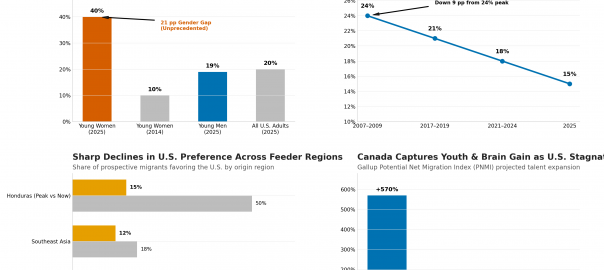
America’s Gendered Exit: Why 40% of Young Women Want to Leave the U.S.

Sat Oct. 16, 2026 /Mpelembe Media/ — Global migration aspirations have entered a period of structural recalibration, as the proportion of adults worldwide desiring to relocate permanently dipped to 15% in 2025 after sustaining a record peak of 16% between 2021 and 2024. Although the United States remains the single most desired destination globally, its attraction has fallen to a nearly two-decade low of 15% in 2025, down from 24% in the 2007–2009 period. This cooling demand is particularly striking in traditional feeder corridors such as Latin America and the Caribbean (dropping from 33% to 28%) and Southeast Asia (falling from 18% to 12%), with Honduras recording a dramatic 35-percentage-point collapse in U.S. preference. Instead of defaulting to North America, potential migrants are turning toward multipolar regional networks—favoring Japan in Southeast Asia, Germany in the Middle East, and Spain in Europe—while Canada solidly maintains its position as the second most preferred global destination at 9% (representing ~85 million adults). Continue reading →

16Oct/26

Parental Alienation in Custody Battles

Navigating High-Conflict Family Law: Distinguishing Parental Alienation, Realistic Estrangement, and Legal Realities

Fri 16 Oct 2026 /Mpelembe Media/ — Parent-child contact refusal following marital separation or divorce is primarily evaluated through two distinct clinical constructs: parental alienation and realistic estrangement. Parental alienation occurs when a child persistently rejects and denigrates a targeted parent without legitimate, objective justification, driven by the psychological manipulation, badmouthing, and gatekeeping behaviors of the preferred parent. Conversely, realistic estrangement represents a justified rejection resulting from the child’s actual baseline experience of physical, sexual, or emotional abuse, severe neglect, or domestic violence. Psychologically, alienated children display cognitive splitting—idealizing the preferred parent as entirely good while devaluing the targeted parent as entirely evil—and exhibit a complete lack of ambivalence. Realistically estranged children, in contrast, maintain psychological ambivalence, holding grounded fears paired with nuanced recollections of both positive and negative parental traits. Diagnostic tools such as the Parental Acceptance–Rejection Questionnaire (PARQ-Gap) quantify this degree of splitting to objectively differentiate severe alienation from justified estrangement with high statistical accuracy. Continue reading →

06Oct/26

Why Staying Home Is the Ultimate Luxury

The Luxury of Doing Nothing: Redefining Success Through Peace, Boundaries, and Rest

In a hyper-connected world that constantly celebrates activity, socializing, and external validation, modern freedom and true luxury are being redefined around quietness, solitude, and intentional disconnection. Simple acts like staying at home, enjoying favorite snacks, and setting firm personal boundaries allow individuals to protect their peace and step away from relentless external noise. This mindset drives the shift from FOMO (the fear of missing out) to JOMO (the joy of missing out), where establishing screen boundaries and engaging in analog activities helps reclaim time, lower stress, and foster creativity and mental clarity. Continue reading →

05Oct/26

AI Sales Agents and Server Side Tracking

Turn Natural Prompts into Production-Ready CRM Assets

Mon 05 Oct 2026 /Mpelembe Media/ — AI Studio is a conversational, prompt-powered builder embedded directly within HighLevel sub-accounts that enables users to generate complete digital web assets through natural language instructions. Rather than building isolated frontend pages that rely on third-party webhooks or external integration layers, AI Studio constructs web assets natively within the platform’s operational CRM database. This architecture eliminates integration failure vectors and data loss during multi-domain redirects, providing a rapid path from concept to live deployment. Continue reading →