Tag Archives: Ghana

02Nov/26

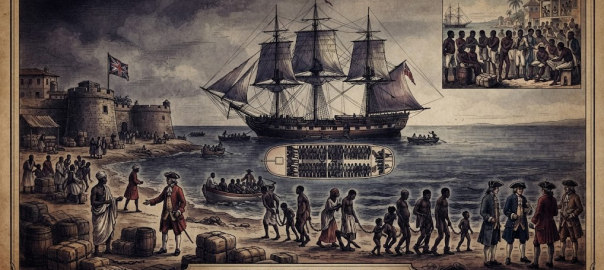
The Legal Architecture of Modern Reparations

From Apologies to Systemic Reform: The Emerging Global and Local Blueprint for Slavery Reparations

Sun, Nov 01 2026 /Mpelembe Media/ — The contemporary discourse surrounding slavery, systemic exploitation, and reparatory justice operates across a dynamic continuum that bridges digital public opinion, international legal doctrines, and concrete policy proposals. In the digital sphere, public debate on social media is heavily polarized between demands for historical restitution—which frame modern racial and economic disparities as the direct legacy of state-sanctioned chattel slavery and colonialism—and counterarguments that prioritize immediate action against modern human trafficking, question intergenerational culpability, or defend sovereign state interests. This online friction reflects foundational tensions within human rights law between universalist approaches focused on immediate harms and historical-contextual frameworks addressing cumulative, structural injustice. Continue reading →
27Oct/26

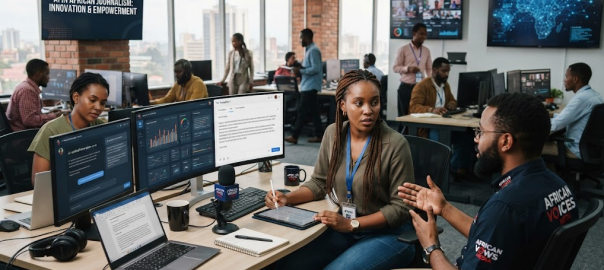
How AI Is Rewriting the News

Optimists, Pessimists, and Pragmatists: Navigating the Cultural and Ethical Realities of AI in African Journalism

Mon, July 26 2026 /Mpelembe Media/ — The JournalismAI initiative, hosted by Polis at the London School of Economics and Political Science (LSE) in partnership with the Google News Initiative, has undergone a major strategic transition to foster responsible artificial intelligence adoption across global newsrooms. Having trained thousands of media professionals through its initial JournalismAI Academy model, the initiative launched the JournalismAI Strategy Lab to shift the industry focus from basic tool experimentation toward structured institutional governance and workflow integration. Crucially, the program expanded its geographic mandate from Sub-Saharan Africa to a pan-African scope, encompassing North, West, East, Central, and Southern Africa. Delivered as a no-cost, five-week virtual initiative, the Strategy Lab guides non-technical newsroom decision-makers through five cumulative modules covering core AI concepts, workflow infrastructure, generative AI applications, ethical governance, and project implementation. Continue reading →

24Oct/26

Why AI Detectors Flag African Writers

Flawed Metrics and Market Tropes: The Paradox Facing Black Writers in the AI Era

Sat Oct. 24, 2026 /Mpelembe Media/ — The controversy surrounding Zimbabwean author Simbarashe Steyn Kundizeza’s 2026 Caine Prize win has ignited an international debate over artificial intelligence, literary authenticity, and algorithmic bias in publishing. On October 6, 2026, Kundizeza was awarded the £10,000 Caine Prize for African Writing for his short story “The Blue Fighter”. Five days later, journalist Vauhini Vara reported in The Atlantic that the commercial AI detection tool Pangram had flagged virtually the entire story as machine-generated text. Kundizeza forcefully rejected the accusation, asserting that the story drew directly from his personal life, lived experience, and a writing residency in Ghana. In response, the Caine Prize Foundation launched a human-centred review—interviewing the author and judges and examining manuscript draft histories rather than relying on automated software scores as dispositive proof of misconduct. Continue reading →

23Oct/26

How War and Climate Break Supply Chains

Global Economic Impacts of the 2026–2027 Super El Niño

The Severity of the Climate Shock in a Fragile Macro Context

Fri Oct. 23, 2026 /Mpelembe Media/ — The 2026–2027 El Niño climate event is developing into one of the most severe episodes on record, with equatorial Pacific sea-surface temperature anomalies projected to exceed +2°C to +3°C. Meteorological authorities assign a greater than 90% probability to a very strong event, with a 75% likelihood of exceeding the intensity of historical benchmarks recorded since 1950. Unlike previous cycles, this climate phenomenon collides with an exceptionally fragile macroeconomic environment characterized by historically elevated public debt, high interest rates, ongoing geopolitical tensions, and pre-existing supply chain frictions. Continue reading →

17Oct/26

Why America Is Losing Global Talent

America’s Gendered Exit: Why 40% of Young Women Want to Leave the U.S.

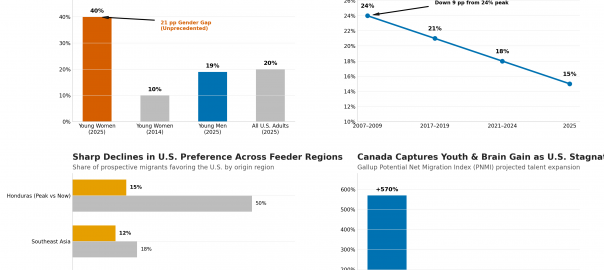
Sat Oct. 16, 2026 /Mpelembe Media/ — Global migration aspirations have entered a period of structural recalibration, as the proportion of adults worldwide desiring to relocate permanently dipped to 15% in 2025 after sustaining a record peak of 16% between 2021 and 2024. Although the United States remains the single most desired destination globally, its attraction has fallen to a nearly two-decade low of 15% in 2025, down from 24% in the 2007–2009 period. This cooling demand is particularly striking in traditional feeder corridors such as Latin America and the Caribbean (dropping from 33% to 28%) and Southeast Asia (falling from 18% to 12%), with Honduras recording a dramatic 35-percentage-point collapse in U.S. preference. Instead of defaulting to North America, potential migrants are turning toward multipolar regional networks—favoring Japan in Southeast Asia, Germany in the Middle East, and Spain in Europe—while Canada solidly maintains its position as the second most preferred global destination at 9% (representing ~85 million adults). Continue reading →

10Sep/26

How African Filmmakers Reclaimed the Screen

Beyond the Colonial Shadow: The Financial Risk and Cultural Triumph of Love Brewed in the African Pot

From Objects to Authors: The Evolution of African Cinema

1. The Paternalistic Era: Cinema as a Colonial Tool (1900–1950s)

The history of cinema in Africa began not as an indigenous art form, but as a colonial novelty. In 1900, a French circus group projected the Lumière brothers’  L’arroseur arrosé  in a Dakar marketplace, a moment that marked the arrival of a medium that would be used for decades to document Europe’s “Other.” Early European cinema focused on newsreels and ethnographic studies that prioritized colonial solidarity, often erasing indigenous tensions to present a sanitized view of the continent.To control the African “gaze,” colonial administrations established dedicated film units. While their methods overlapped, their underlying motivations were distinct: Continue reading →

24Aug/26

Why joblessness and diamonds fuel civil war

The Dual Private Sector Dilemma: Why IMF Market-Led Growth Models Fail to Create Jobs in Fragmented African Economies

Mon, Aug 24 2026 /Mpelembe Media/ — The economic relationship between sub-Saharan Africa and the International Monetary Fund (IMF) has its roots in the 1944 Bretton Woods Conference, where the few developing nations present failed to secure explicit references to their development financing needs in the Articles of Agreement. From its inception, the IMF maintained a rigid, short-term balance-of-payments focus, famously denying Ethiopia’s first request for financial assistance on the grounds that its needs were neither immediate nor temporary. By the 1980s and 1990s, this short-term framework was formalized into neoliberal Structural Adjustment Programs (SAPs), which mandated strict conditionalities such as market deregulation, extensive privatization of state-owned enterprises, and rapid trade opening. Although promoted as pathways to long-term macroeconomic stability, these interventions frequently triggered severe adverse social consequences, including declining real wages, heightened poverty, and the systematic deterioration of basic health and social welfare systems. In response to widespread critique in the late 1990s, the IMF purported to shift its operational model, replacing traditional SAPs with the Enhanced Structural Adjustment Facility (ESAF) and, subsequently, various credit facilities under the Poverty Reduction and Growth Trust (PRGT). However, empirical evidence indicates that these contemporary programs represent “SAPs in disguise,” with loan conditionalities and stringency steadily rising, and core prescriptions of fiscal consolidation and state retrenchment remaining largely unchanged. Continue reading →

23Aug/26

AI Ethics Dumping and 2Africa Cables

Countering AI Ethics Dumping: African Nations Mobilize for True Digital Autonomy

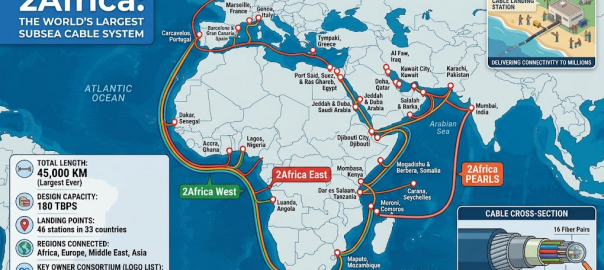
Sun, Aug 23 2026 /Mpelembe Media/ — Africa is undergoing a profound digital infrastructure revolution, shifting from historical neglect where international communications bypassed its coastlines to becoming a key hub of global data transit. This physical transformation is anchored by massive subsea cable projects driven by global technology giants. Foremost among these is Meta’s 2Africa cable system, the longest undersea telecommunications cable in the world at 45,000 kilometers, connecting 46 landing stations in 33 countries across Africa, Asia, and Europe. Boasting a design capacity of up to 180 Terabits per second, this project is expected to boost Africa’s cumulative GDP by $36.9 billion in its first few years of operation. Simultaneously, Google’s privately-funded Equiano cable runs along the western seaboard from Portugal to South South Africa, integrating space-division multiplexing to deliver 20 times the network capacity of previous regional cables. The economic impact of Equiano is massive, with projected GDP increases of $11.1 billion in Nigeria, $5.8 billion in South South Africa, and $290 million in Namibia. Continue reading →

07Aug/26

Why the World Is Bypassing the Dollar

Zambia’s Closed-Loop Monetary Strategy: Balancing Retail De-Dollarization with Sovereign Copper Finance

Fri , Aug 0& 2026 /Mpelembe Media/ — Sub-Saharan Africa is undergoing a profound structural transformation as sovereign nations systematically seek to reduce their historic reliance on the United States dollar for reserves, trade invoicing, and domestic transactions. For decades, the US dollar served as the undisputed financial anchor across the continent, but this deep integration has exposed emerging economies to extreme macro-financial vulnerabilities, particularly during cycles of US Federal Reserve monetary tightening. When interest rates rise in Washington, global capital retreats to dollar-denominated assets, triggering sharp depreciations of local African currencies that inflate the cost of imported goods and escalate the servicing costs of dollar-denominated sovereign debt. This systemic vulnerability was starkly demonstrated in November 2020 when Zambia defaulted on a $42.5 million Eurobond payment, with the concurrent strength of the US dollar significantly exacerbating the domestic financial fallout. Furthermore, the geopolitical landscape of the mid-2020s has accelerated the search for alternative payments due to the perceived weaponization of Western-dominated dollar-clearing systems, prompting African policymakers to seek bilateral trade architectures and payment systems backed by the BRICS+ alliance to protect their economic sovereignty. Continue reading →

23Jul/26

Your Passport Is a Geopolitical Weapon

The 20-Year Global Mobility Shift

Thu, July 23 2026 /Mpelembe Media/ — The 20-year retrospective analysis of global mobility reveals a profound geopolitical realignment, characterized by the expansion of average travel freedom alongside a starkly polarizing divide between the world’s most and least mobile populations.

Continue reading →