Tag Archives: Microsoft

29Jul/26

ASML panic and AI circular funding

Historic Tech Plunge: Asian Markets Tumble Amid Fears of Unsustainable AI Spending and New Chinese Rivals

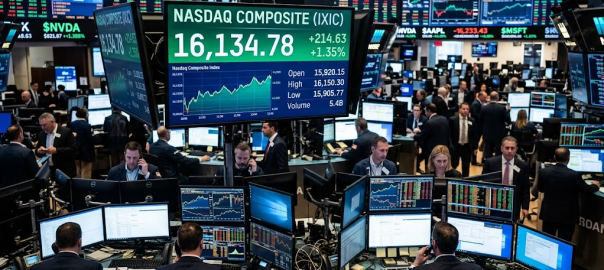
Wed, July 29 2026 /Mpelembe Media/ — The summer of 2026 witnessed a profound global market recalibration as major technology and semiconductor stocks faced a severe sell-off, pushing the tech-heavy Nasdaq-100 index into correction territory. This downturn reflected a fundamental shift in investor sentiment, moving from speculative optimism surrounding artificial intelligence to a rigorous demand for tangible monetization and balance sheet stability. The correction was not triggered by a singular event, but rather by a confluence of escalating capital expenditures, systemic credit risks tied to circular financing, and significant geopolitical shifts in the Asian semiconductor supply chain. Continue reading
29Jul/26

Why Zuckerberg is Building an AI CEO

Friction in the Labs: Delays, Layoffs, and Culture Clashes Inside Meta’s Superintelligence Push

Wed, July 29 2026 /Mpelembe Media/ — The Open-Source Vision and Industry Dominance Meta CEO Mark Zuckerberg is aggressively positioning the company as the primary institutional sponsor of open-source (open-weight) artificial intelligence. With the release of Llama 3.1, Zuckerberg argues that open-source AI is the path forward because it empowers developers, prevents centralization of power, and allows organizations to protect their data without being locked into closed vendor ecosystems like those of Apple, OpenAI, or Google. By freely distributing its models, Meta hopes to commoditize the AI layer and establish Llama as the ubiquitous global industry standard. Continue reading

23Jul/26

Why Kimi and DeepSeek Terrify Superpowers

The Geopolitics of Chinese Open-Weight AI

Thu, July 23 2026 /Mpelembe Media/ —The global artificial intelligence landscape is undergoing a major structural shift driven by the rapid technical maturation and aggressive pricing of open-weight models originating from China, specifically Moonshot AI’s Kimi K3 and DeepSeek’s V4 Pro. While these models offer massive cost efficiencies for Western enterprises, they introduce severe national security, cybersecurity, and intellectual property concerns, prompting a pivot in Washington toward weaponized regulatory uncertainty, federal procurement restrictions, and supply chain mapping.
Continue reading

The New Creator Economy: Why Storytelling and Taste are the Ultimate AI-Era Differentiators

Beyond the Prompt: Building Defensible AI Products in a World of Commoditized Intelligence

Tue, Jun 02 2026 /Mpelembe Media/ — The “idea-to-scale” cycle has been weaponized. In previous tech cycles, the distance between a concept and global execution was measured in years; today, it is measured in weeks. We are witnessing the “Great Compression”—a collapse of the traditional barriers to production that has left many in a state of “AI fatigue.” If you believe AI is just a chatbot in a browser, you’ve already lost the plot.We are transitioning from simple orchestration to the era of “vibe design.” In this new landscape, multi-modal interaction is the baseline, and the ability to describe a vision or feel an outcome is the new coding. For the tech strategist, the goal isn’t just to use AI, but to identify the counter-intuitive shifts rewiring how humans and machines interface.
Continue reading

29May/26

Beyond Chatbots: How Robinhood, Visa, and Google are Building the Rails for Agentic Commerce

The $135 Billion Protocol War: Inside the Race to Standardize AI-Driven Transactions

Sat, May 30 2026 /Mpelembe Media/ — Robinhood’s Pioneering Launch Robinhood has officially ushered in the era of “agentic finance” by launching two flagship products: Agentic Trading and the Agentic Credit Card. Utilizing the Model Context Protocol (MCP), these tools allow retail investors to connect third-party AI agents (like Claude or ChatGPT) directly to Robinhood’s infrastructure to execute financial decisions autonomously. Continue reading

26May/26

Inside the Agentic Enterprise of 2026

The Age of Autonomy: How Multi-Agent Systems are Redefining Enterprise AI in 2026

Tue, May 26 2026 /Mpelembe Media/ — In 2026, the technology landscape has firmly transitioned from conversational generative AI to autonomous, multi-agent AI ecosystems. Rather than waiting for step-by-step human prompts, these AI agents can independently reason, plan, use tools, and collaborate to execute complex workflows across enterprise systems. Continue reading

20May/26

The Death of Doomscrolling and the Birth of AI Agents: Everything Announced at Google I/O 2026

Tue, May 19 2026 /Mpelembe Media/ — Google I/O 2026 and the preceding Android Show marked a major pivot for Google towards an “agentic era,” where AI transitions from a passive assistant to a proactive, autonomous system. Google introduced advanced models like Gemini Omni and Gemini 3.5, which are designed to perform complex actions rather than just generating text. A major focus was placed on Google Antigravity, a development platform that enables creators to build autonomous agents for various tasks. These innovations extend across the company’s ecosystem, including intelligent eyewear, a universal shopping cart, and enhanced scientific research tools. Furthermore, the updates emphasize multimodal capabilities and new creative applications such as Google Pics and Stitch. Ultimately, the source portrays a future where proactive AI assistants are deeply integrated into search, hardware, and professional workflows. Continue reading

14May/26

Your AI is now an autonomous coworker

Meet Your New Digital Coworker: 15 AI Workflows Redefining Small Business Operations

Thur, May 14 2026 /Mpelembe Media/ — Anthropic has officially launched Claude for Small Business, an intelligent operating layer built into its desktop agent, Claude Cowork, designed to automate complex, multi-step administrative tasks for SMBs. Moving beyond a traditional chatbot interface, this package embeds directly into the software stack small businesses already rely on, connecting to platforms like Intuit QuickBooks, PayPal, HubSpot, Canva, Docusign, Google Workspace, Microsoft 365, and Slack. Continue reading

20Apr/26

Claude Mythos triggers global cyber panic

The Mythos Inflection: How Anthropic’s New AI is Rattling Global Finance

April 20, 2026 /Mpelembe Media/ — The Emergence of Autonomous AI Cyber Threats Anthropic’s recent announcement of Claude Mythos Preview has fundamentally disrupted the cybersecurity landscape, marking a transition from AI as a productivity tool to an autonomous offensive cyber weapon. The model has demonstrated an unprecedented ability to discover and exploit zero-day vulnerabilities at machine speed, autonomously uncovering decades-old flaws in systems like OpenBSD, FFmpeg, and the Linux kernel without human intervention. Cybersecurity experts warn this creates an “AI Vulnerability Storm”, collapsing the timeline between a vulnerability’s discovery and its weaponization from months to mere hours. Continue reading

18Apr/26

The Humans Behind the AI Illusion

April 18, 2026 /Mpelembe Media/ — These sources analyze the shift toward precarious labor and contracting within the modern economy, with a particular focus on the technology sector. One report highlights the exploitation of data workers in the United States, revealing that those who train artificial intelligence often face low wages, unstable hours, and a lack of essential mental health benefits. Parallel research examines the broader gig economy, noting that while some high-skilled professionals choose independent contracting for its autonomy, many others are forced into these roles by restructuring or a lack of traditional opportunities. This transition often results in limited employer-provided training and the erosion of job security, creating a “race to the bottom” for workers across various demographics. Ultimately, the collection illustrates how algorithmic management and subcontracting are redefining the relationship between firms and employees, often prioritizing corporate flexibility and profits over worker stability. Continue reading