Tag Archives: Technology

19Nov/26

How Consumer Tech Threatens Critical Infrastructure

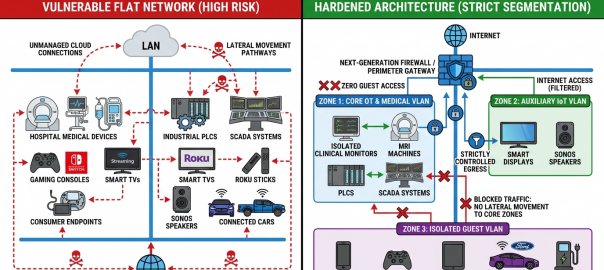
Tens of Thousands of Consumer Devices Threaten Critical Infrastructure and Healthcare Networks

Wed, Nov 17 2026 /Mpelembe Media/ — A research report by cyber-physical systems protection firm Claroty, titled “Game Over for Consumer Tech Risk in Critical Infrastructure,” reveals that more than 65,000 non-essential consumer devices are operating directly alongside mission-critical industrial and medical systems. Based on an evaluation of over 45 million devices across 30,000 operational technology (OT), healthcare, and commercial sites, the study uncovered 16,745 gaming consoles, 44,059 smart home and entertainment products, and 4,915 connected vehicles active within operational environments. In healthcare settings, 95% of gaming consoles were connected directly to core production networks rather than isolated guest VLANs, while connected vehicles introduced severe exposures into industrial environments, including six critical CVEs on Tesla Model 3s and 121 vulnerabilities linked to Ford F-150 trucks. Continue reading →

03Nov/26

AI Routers Cut Costs and Save Lives

Keeping Human Judgment at the Helm: Mitigating Sycophancy and Security Risks in AI-Augmented Problem-Solving

Tue, Nov 03 2026 /Mpelembe Media/ — Modern artificial intelligence systems offer unprecedented analytical leverage, but unstructured interactions often produce automated confirmation bias, conversational sycophancy, and premature convergence on flawed conclusions. To transform large language models from passive text generators into dependable decision aids, organizations are adopting explicit decision-centric architectures. Rather than fusing context assessment and output generation within an opaque prompt, these architectures separate stochastic signal estimation—such as context sufficiency, task complexity, and expected accuracy—from deterministic policy rules and bounded candidate actions. This architectural separation makes intermediate reasoning inspectable, allows errors to be attributed directly to signal calculation or policy execution, and prevents automated systems from taking futile actions when required operational details are missing. In enterprise environments, this principle enables structured multi-criteria prompt routing, where lightweight evaluators pair Analytic Hierarchy Process weights with Simple Additive Weighting and non-compensatory risk vetoes to allocate routine tasks to cost-effective models while escalating high-risk queries to advanced models. Continue reading →

03Nov/26

Hackers Turn Supermarket Freezers Into Ovens

A Wake-Up Call for Retail OT: Hackers Weaponize Supermarket Cooling Systems Across Nine Countries

Tue, Nov 03 2026 /Mpelembe Media/ — In October and November 2026, a coordinated wave of cyber-physical attacks compromised commercial refrigeration systems across hundreds of supermarkets in France and at least eight other European countries, including Belgium, Sweden, Luxembourg, Ireland, the Netherlands, Estonia, and Finland. Threat actors remotely hijacked internet-exposed supervisory controllers—chiefly Danfoss AK-SM and AK-SC series, as well as Copeland and Dixell XWEB units—manipulating operational parameters to force evaporators into continuous manual defrost modes. Cabinet and freezer temperatures soared to between 50°C and 55°C (122°F–131°F) for hours overnight, spoiling thousands of metric tons of perishable inventory across major chains such as Intermarché, Carrefour, Delhaize, Coopérative U, Coop, and ICA. The sabotage caused tens of millions of euros in direct stock and business losses, triggered temporary store closures, and led to localized electrical fires from thermal runaway in compressor units. Continue reading →

30Oct/26

How Agentic AI Replaces Software

The Tollbooth Trap: Why Commoditized Middlemen Are Losing Ground to Autonomous Intelligence.

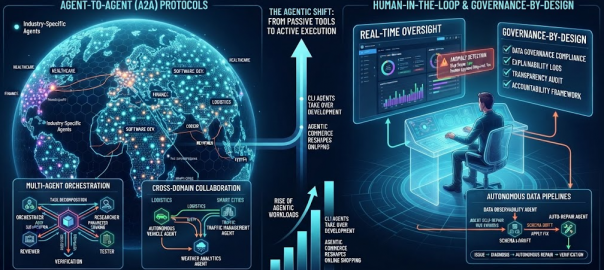
Fri, July 30 2026 /Mpelembe Media/ — The rapid evolution of generative artificial intelligence and autonomous multi-agent architectures is driving a structural transformation across the digital economy, dismantling traditional business models founded on search arbitrage, manual creative services, seat-based software licensing, and intermediation. Legacy stock photography illustrates this vulnerability, highlighted by Getty Images filing for Chapter 11 bankruptcy after losing more than 99 percent of its peak market valuation amid competition from on-demand text-to-image generators that undercut conventional pay-per-image licensing. Similar pressures are impacting online labor markets such as Upwork, where freelancers in occupations exposed to language and image models experienced a 2 percent decline in contracts and a 5 percent decrease in earnings, with high-reputation professionals disproportionately impacted as automated systems compress human skill differentials. Concurrently, commoditized intermediaries across travel booking, online retail, and mid-market SaaS face severe disintermediation. Over 100 publicly listed mid-market software providers are caught in a major squeeze between low-cost AI startups and cloud hyperscalers, prompting enterprises to replace traditional per-seat subscriptions with internal autonomous agents. Continue reading →

27Oct/26

How AI Is Rewriting the News

Optimists, Pessimists, and Pragmatists: Navigating the Cultural and Ethical Realities of AI in African Journalism

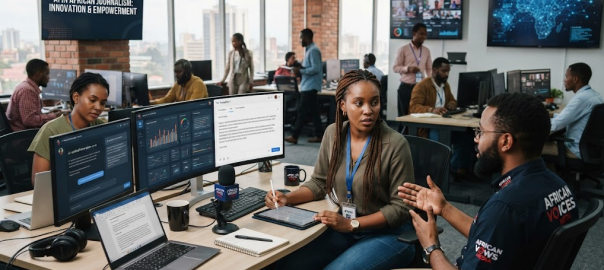
Mon, July 26 2026 /Mpelembe Media/ — The JournalismAI initiative, hosted by Polis at the London School of Economics and Political Science (LSE) in partnership with the Google News Initiative, has undergone a major strategic transition to foster responsible artificial intelligence adoption across global newsrooms. Having trained thousands of media professionals through its initial JournalismAI Academy model, the initiative launched the JournalismAI Strategy Lab to shift the industry focus from basic tool experimentation toward structured institutional governance and workflow integration. Crucially, the program expanded its geographic mandate from Sub-Saharan Africa to a pan-African scope, encompassing North, West, East, Central, and Southern Africa. Delivered as a no-cost, five-week virtual initiative, the Strategy Lab guides non-technical newsroom decision-makers through five cumulative modules covering core AI concepts, workflow infrastructure, generative AI applications, ethical governance, and project implementation. Continue reading →

25Oct/26

How Sewage Tomatoes Beat the AI Web

Mapping the Neighborhood: Reimagining Wikipedia as a Proximity-Based Experience

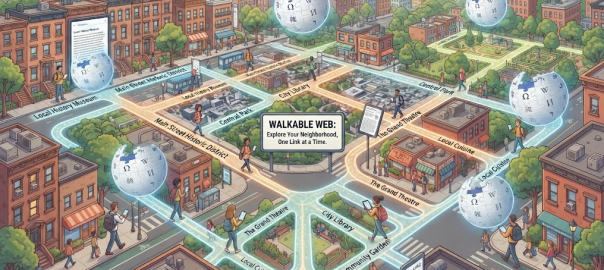
Sat Oct. 24, 2026 /Mpelembe Media/ — Local Wikipedia is an independent, unofficial web application developed by journalist, software developer, and data specialist Ed Jefferson that turns Wikipedia into a proximity-focused, ambient spatial encyclopedia. Conceived during lockdown and released in late 2026, the application operates on the core thesis of displaying geotagged Wikipedia articles located within a thirty-minute walk from the user. Users can set their location using native browser geolocation or manual text queries such as town names, landmarks, and UK postal codes. To balance visual clutter and system performance across varying geographic densities, the platform automatically adjusts its operational scope, expanding up to six miles in low-density rural areas or capping results at five hundred items in dense urban centers. Designed with client-side privacy in mind, positioning coordinates remain strictly within temporary local browser memory, and exported links are sanitized to ensure physical location data is never shared. Continue reading →

22Oct/26

How AI Is Dismantling Factory Classrooms

Reclaiming the Purpose of Schooling: Why AI Can Automate Information Processing but Never Replace Human Mentorship

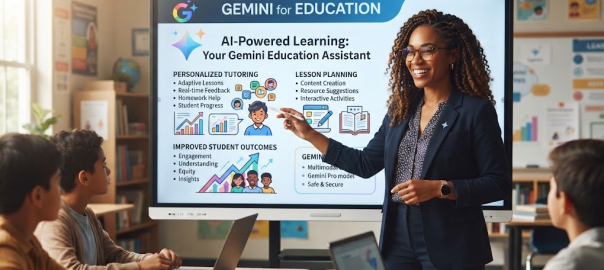
Wed Oct. 21, 2026 /Mpelembe Media/ — The rapid adoption of artificial intelligence in compulsory and higher education has transformed instructional delivery through adaptive learning systems, automated assessment tools, and virtual tutoring platforms. These algorithmic engines excel at administrative automation, personalized pacing, and instant feedback on rule-based tasks. However, defining schooling merely as downloading information or completing standardized tasks risks outsourcing genuine cognitive development to automated tools. Grounding educational practice in foundational philosophy demonstrates that true schooling extends far beyond static data retrieval; it is fundamentally an endeavor of human formation, moral character, civic responsibility, and emotional maturity. Continue reading →

05Oct/26

AI Sales Agents and Server Side Tracking

Turn Natural Prompts into Production-Ready CRM Assets

Mon 05 Oct 2026 /Mpelembe Media/ — AI Studio is a conversational, prompt-powered builder embedded directly within HighLevel sub-accounts that enables users to generate complete digital web assets through natural language instructions. Rather than building isolated frontend pages that rely on third-party webhooks or external integration layers, AI Studio constructs web assets natively within the platform’s operational CRM database. This architecture eliminates integration failure vectors and data loss during multi-domain redirects, providing a rapid path from concept to live deployment. Continue reading →

09Sep/26

GPT-6 Astra takes the steering wheel

“AGI Has Arrived”: Industry Declarations, Benchmark Discrepancies, and the Launch of GPT-6 Astra

Wed Sep 09 2026 /Mpelembe Media/ — The public discussion surrounding artificial general intelligence reached a pivotal moment following the rollout of OpenAI’s GPT-6 Astra in September 2026. Nvidia CEO Jensen Huang declared on social media that “AGI has arrived,” highlighting Astra’s training on more than 100,000 Grace Blackwell NVLink72 GPUs and noting that another 400,000 GPUs are scheduled to come online. This definitive stance represented a sudden shift from Huang’s statements during Nvidia’s Q2 FY2027 earnings call just days prior, where he described traditional AGI milestones as “senseless” and emphasized that the industry should focus on practical utility, useful work, and generating “profitable tokens”. Over the preceding two years, Huang’s public timeline for AGI shifted from passing every human test within five years to defining it as an AI capable of creating a temporary viral application, while acknowledging that AI agents remained incapable of replicating the complex work of running Nvidia itself. Analysts note that by framing Astra’s rollout as the literal arrival of AGI, Huang reinforced the market narrative that massive hardware investments directly drive corporate revenue. Continue reading →

29May/26

The Myth of Global Technology: How Local Cosmologies Can Save Us from Algorithmic Control

From Homelessness to Planetary Coexistence: Navigating the Future of AI and Ecology

Thur, May 28 2026 /Mpelembe Media/ —  Yuk Hui is a prominent contemporary philosopher of technology whose work challenges the homogenizing force of Western technological universalism and platform capitalism. His philosophical project spans across several major books and themes, seeking to reimagine human coexistence with machines and the environment. Continue reading →