Tag Archives: Brazil

01Nov/26

Ed Sheeran and Sampa Beat the System

Sampa the Great Reclaims Her Bloodline and Reinvents Zambian Rock on ‘Nu Zamrock’

Sun, Nov 01 2026 /Mpelembe Media/ — Sampa the Great (Sampa Tembo) released her third studio album, Nu Zamrock, on October 30, 2026, through Loma Vista Recordings. Spanning 16 tracks across 37 minutes, the record represents an autobiographical reclamation, an intergenerational dialogue, and a modern sonic expansion of Zambia’s foundational 1970s rock movement. Co-executive produced by Sampa alongside Grammy-winning producer Cadenza, the album was crafted across intensive writing sessions in Botswana, production work in Lusaka with Zambian producers Magnus Mando (Mag44) and Solomon Moyo, and finishing sessions in Los Angeles. Rather than treating the project as retro-nostalgia, Sampa describes the record as “the future remembering where it came from,” blending overdriven psychedelic rock guitars and kalindula polyrhythms with hard-hitting hip-hop, poetry, and soul. Continue reading →
27Oct/26

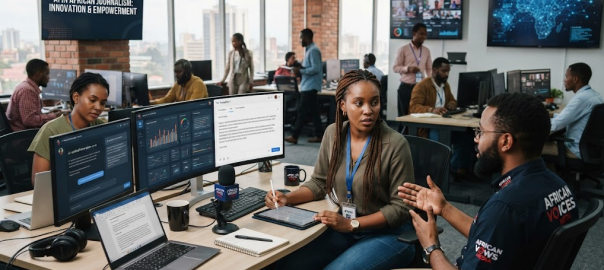
How AI Is Rewriting the News

Optimists, Pessimists, and Pragmatists: Navigating the Cultural and Ethical Realities of AI in African Journalism

Mon, July 26 2026 /Mpelembe Media/ — The JournalismAI initiative, hosted by Polis at the London School of Economics and Political Science (LSE) in partnership with the Google News Initiative, has undergone a major strategic transition to foster responsible artificial intelligence adoption across global newsrooms. Having trained thousands of media professionals through its initial JournalismAI Academy model, the initiative launched the JournalismAI Strategy Lab to shift the industry focus from basic tool experimentation toward structured institutional governance and workflow integration. Crucially, the program expanded its geographic mandate from Sub-Saharan Africa to a pan-African scope, encompassing North, West, East, Central, and Southern Africa. Delivered as a no-cost, five-week virtual initiative, the Strategy Lab guides non-technical newsroom decision-makers through five cumulative modules covering core AI concepts, workflow infrastructure, generative AI applications, ethical governance, and project implementation. Continue reading →

24Oct/26

Zambia’s Rule of Law Paradox

Beyond the Composite Score: Bridging the Implementation Gap in Zambia’s Legal System

Sat Oct. 24, 2026 /Mpelembe Media/ — In the 2026 World Justice Project (WJP) Rule of Law Index, Zambia registers an overall composite score of 0.44 on a scale from 0.00 to 1.00, placing it 108th globally out of 143 surveyed countries. This performance marks a single-position drop in global standing and a minor 0.01 score contraction from the 0.45 baseline maintained between 2022 and 2025. Regionally, Zambia ranks 19th out of 34 Sub-Saharan African states, placing its score slightly below the regional benchmark of 0.45 and well beneath the global average of 0.55. Despite this global deficit, Zambia maintains a solid standing within its lower-middle-income cohort, outperforming regional neighbors such as Nigeria (120th) and Zimbabwe (122nd). Historically, Zambia reached a decade-high score of 0.48 in 2016 before political polarization eroded it to 0.44 in 2021; while the peaceful transfer of power in late 2021 stabilized scores at 0.45 through 2025, administrative bottlenecks led to the slight 2026 contraction. Continue reading →

23Oct/26

How War and Climate Break Supply Chains

Global Economic Impacts of the 2026–2027 Super El Niño

The Severity of the Climate Shock in a Fragile Macro Context

Fri Oct. 23, 2026 /Mpelembe Media/ — The 2026–2027 El Niño climate event is developing into one of the most severe episodes on record, with equatorial Pacific sea-surface temperature anomalies projected to exceed +2°C to +3°C. Meteorological authorities assign a greater than 90% probability to a very strong event, with a 75% likelihood of exceeding the intensity of historical benchmarks recorded since 1950. Unlike previous cycles, this climate phenomenon collides with an exceptionally fragile macroeconomic environment characterized by historically elevated public debt, high interest rates, ongoing geopolitical tensions, and pre-existing supply chain frictions. Continue reading →

22Oct/26

How AI Is Dismantling Factory Classrooms

Reclaiming the Purpose of Schooling: Why AI Can Automate Information Processing but Never Replace Human Mentorship

Wed Oct. 21, 2026 /Mpelembe Media/ — The rapid adoption of artificial intelligence in compulsory and higher education has transformed instructional delivery through adaptive learning systems, automated assessment tools, and virtual tutoring platforms. These algorithmic engines excel at administrative automation, personalized pacing, and instant feedback on rule-based tasks. However, defining schooling merely as downloading information or completing standardized tasks risks outsourcing genuine cognitive development to automated tools. Grounding educational practice in foundational philosophy demonstrates that true schooling extends far beyond static data retrieval; it is fundamentally an endeavor of human formation, moral character, civic responsibility, and emotional maturity. Continue reading →

02Sep/26

Newsrooms fight for survival against AI

Ethics in Action: Preserving Human Judgment Amid the Rise of Generative News

Tue Sep 01 2026 /Mpelembe Media/ — The global expansion of artificial intelligence has created a landscape of digital hegemony where standard-setting and economic benefits are heavily concentrated in the Global North, establishing a form of digital extractivism that mirrors historical colonial dynamics. Large technology conglomerates utilize content harvested from global networks to train proprietary models and sell them back as subscriptions. This extraction is accompanied by a severe decline in search referral traffic, which has collapsed by 50% to 60% in critical emerging markets like Brazil, South Africa, and Indonesia. This occurs because conversational search engines summarize copyrighted reporting directly on results pages, bypassing clicks to the original publisher. In response, major nations in the Global South are reframing the AI debate, moving from historical strategies of diplomatic non-alignment directly into the digital realm. Media leaders and policymakers in these regions argue that AI must not be treated as an isolated technical novelty, but as a critical national sovereignty, labor, and industrial policy issue that fundamentally impacts the health of local information environments. Continue reading →

18Aug/26

Why your brain hates being a sucker

The Anatomy of Sugrophobia: Why We Dread Being Played for a Fool

Tue, Aug 18 2026 /Mpelembe Media/ — The ubiquitous fear of being duped, or played for a fool, is a powerful and underappreciated driver of human behavior that can escalate into a true phobia known as sugrophobia. Coined in 2007 by experimental psychologists Kathleen Vohs, Roy Baumeister, and Jason Chin, sugrophobia represents the specific, anticipatory dread that someone is taking advantage of us, partly due to our own choices. While a baseline level of wariness is highly adaptive, excessive skepticism can paralyze our ability to trust and cooperate. Unlike passive forms of misfortune such as pickpocketing, being suckered involves our active consent or participation; when a deception is revealed, we are forced to see an element of ourselves in the event, triggering a painful “sucker in the mirror” phenomenon characterized by deep self-blame, anticipated humiliation, and cognitive dissonance. This deep aversion is not limited to major frauds but is triggered daily in low-stakes situations—such as yielding to an aggressive driver, overpaying for lunch, or taking on the workload of a slacker colleague. Continue reading →

23Jul/26

Your Passport Is a Geopolitical Weapon

The 20-Year Global Mobility Shift

Thu, July 23 2026 /Mpelembe Media/ — The 20-year retrospective analysis of global mobility reveals a profound geopolitical realignment, characterized by the expansion of average travel freedom alongside a starkly polarizing divide between the world’s most and least mobile populations.

Continue reading →

15Jul/26

The 2026 World Cup breaks traditional TV

The Death of the Living Room: How CazéTV and YouTube’s 21-Million-Device Milestone Just Ended Linear TV’s Monopoly

The 2026 FIFA World Cup has arrived as a definitive inflection point in media history, signaling a massive disruption in how global sporting events are distributed and monetized. While the tournament’s expansion to 48 teams has provided a gargantuan spectacle on the pitch, the real story is the tectonic shift in consumption habits. We are witnessing the final transition from the “old way” of sports—passive viewing via traditional linear TV—to the era of the “Connected Fan,” defined by mobile-first interaction and creator-led broadcasting.While 6.25 million fans (99.7% occupancy) have packed physical stadiums, these numbers pale in comparison to the digital milestones being set. For strategists and analysts, 2026 isn’t just another World Cup; it is the moment digital platforms effectively decapitated the traditional broadcasting monopoly.
Continue reading →

05Jul/26

How Norway Engineered the Viking Row


The Viking Row (Viking-roing) has emerged as the definitive viral fan sensation of the 2026 FIFA World Cup, transforming a newly developed supporter ritual into a global cultural phenomenon. Continue reading →