Tag Archives: Ghana

24Aug/26

Why joblessness and diamonds fuel civil war

The Dual Private Sector Dilemma: Why IMF Market-Led Growth Models Fail to Create Jobs in Fragmented African Economies

Mon, Aug 24 2026 /Mpelembe Media/ — The economic relationship between sub-Saharan Africa and the International Monetary Fund (IMF) has its roots in the 1944 Bretton Woods Conference, where the few developing nations present failed to secure explicit references to their development financing needs in the Articles of Agreement. From its inception, the IMF maintained a rigid, short-term balance-of-payments focus, famously denying Ethiopia’s first request for financial assistance on the grounds that its needs were neither immediate nor temporary. By the 1980s and 1990s, this short-term framework was formalized into neoliberal Structural Adjustment Programs (SAPs), which mandated strict conditionalities such as market deregulation, extensive privatization of state-owned enterprises, and rapid trade opening. Although promoted as pathways to long-term macroeconomic stability, these interventions frequently triggered severe adverse social consequences, including declining real wages, heightened poverty, and the systematic deterioration of basic health and social welfare systems. In response to widespread critique in the late 1990s, the IMF purported to shift its operational model, replacing traditional SAPs with the Enhanced Structural Adjustment Facility (ESAF) and, subsequently, various credit facilities under the Poverty Reduction and Growth Trust (PRGT). However, empirical evidence indicates that these contemporary programs represent “SAPs in disguise,” with loan conditionalities and stringency steadily rising, and core prescriptions of fiscal consolidation and state retrenchment remaining largely unchanged. Continue reading

23Aug/26

AI Ethics Dumping and 2Africa Cables

Countering AI Ethics Dumping: African Nations Mobilize for True Digital Autonomy

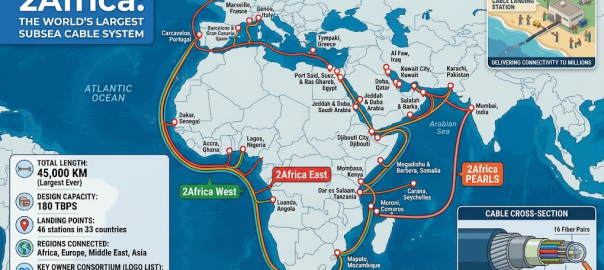
Sun, Aug 23 2026 /Mpelembe Media/ — Africa is undergoing a profound digital infrastructure revolution, shifting from historical neglect where international communications bypassed its coastlines to becoming a key hub of global data transit. This physical transformation is anchored by massive subsea cable projects driven by global technology giants. Foremost among these is Meta’s 2Africa cable system, the longest undersea telecommunications cable in the world at 45,000 kilometers, connecting 46 landing stations in 33 countries across Africa, Asia, and Europe. Boasting a design capacity of up to 180 Terabits per second, this project is expected to boost Africa’s cumulative GDP by $36.9 billion in its first few years of operation. Simultaneously, Google’s privately-funded Equiano cable runs along the western seaboard from Portugal to South South Africa, integrating space-division multiplexing to deliver 20 times the network capacity of previous regional cables. The economic impact of Equiano is massive, with projected GDP increases of $11.1 billion in Nigeria, $5.8 billion in South South Africa, and $290 million in Namibia. Continue reading

07Aug/26

Why the World Is Bypassing the Dollar

Zambia’s Closed-Loop Monetary Strategy: Balancing Retail De-Dollarization with Sovereign Copper Finance

Fri , Aug 0& 2026 /Mpelembe Media/ — Sub-Saharan Africa is undergoing a profound structural transformation as sovereign nations systematically seek to reduce their historic reliance on the United States dollar for reserves, trade invoicing, and domestic transactions. For decades, the US dollar served as the undisputed financial anchor across the continent, but this deep integration has exposed emerging economies to extreme macro-financial vulnerabilities, particularly during cycles of US Federal Reserve monetary tightening. When interest rates rise in Washington, global capital retreats to dollar-denominated assets, triggering sharp depreciations of local African currencies that inflate the cost of imported goods and escalate the servicing costs of dollar-denominated sovereign debt. This systemic vulnerability was starkly demonstrated in November 2020 when Zambia defaulted on a $42.5 million Eurobond payment, with the concurrent strength of the US dollar significantly exacerbating the domestic financial fallout. Furthermore, the geopolitical landscape of the mid-2020s has accelerated the search for alternative payments due to the perceived weaponization of Western-dominated dollar-clearing systems, prompting African policymakers to seek bilateral trade architectures and payment systems backed by the BRICS+ alliance to protect their economic sovereignty. Continue reading

23Jul/26

Your Passport Is a Geopolitical Weapon

The 20-Year Global Mobility Shift

Thu, July 23 2026 /Mpelembe Media/ — The 20-year retrospective analysis of global mobility reveals a profound geopolitical realignment, characterized by the expansion of average travel freedom alongside a starkly polarizing divide between the world’s most and least mobile populations.

Continue reading

20May/26

Zambia Tames Its Deadly Gold Rush

From Copper to Gold: Zambia’s State-Led Blueprint for Formalizing Artisanal Mining

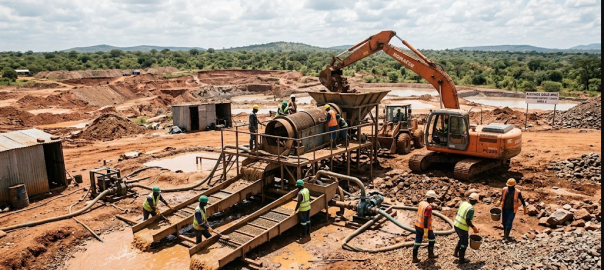
Wed, May 20 2026 /Mpelembe Media/ — Zambia is actively diversifying its mining economy beyond its traditional reliance on copper by executing a structural overhaul of its artisanal and small-scale gold mining (ASGM) sector. The primary catalyst for this shift was a massive, unregulated gold rush in the Kikonge area of Mufumbwe in mid-2025. The sudden influx of thousands of informal miners led to catastrophic safety failures, the emergence of illicit smuggling markets, and deadly clashes with state security forces. Recognizing that military intervention was an unsustainable fix for an economic problem, the Zambian government shifted toward a commercial integration strategy. Continue reading

27Mar/26

The UN Resolution on Slavery Reparations

UN General Assembly Makes History: Declares Transatlantic Slave Trade the “Gravest Crime Against Humanity”

March 27, 2026 /Mpelembe Media/ — On March 25, 2026, coinciding with the International Day of Remembrance of the Victims of Slavery and the Transatlantic Slave Trade, the United Nations General Assembly adopted a historic resolution declaring the transatlantic trafficking of enslaved Africans and racialized chattel enslavement as “the gravest crime against humanity”. Spearheaded by Ghana and heavily supported by the African Union and Caribbean Community (CARICOM), Resolution A/80/L.48 marks a significant shift in international human rights by calling for a comprehensive framework of reparatory justice.

Continue reading

10Feb/26

From Royal Courts to Fashion Diplomacy: How the Siziba and Musisi Became Zambia’s National Pride

The Erotics of the Knee and the Victorian King: Decolonizing Zambia’s “Bird-Like” Silhouette

10 Feb. 2026 /Mpelembe Media  — In the heart of Southern Africa, the visual landscape is a moving gallery of saturated color and structural complexity. To the casual observer, the vibrant fabrics draped across shoulders or swaying in the heat of the Bulozi Plain are simply striking textiles. However, through a cultural lens, the  Chitenge  and the traditional Lozi attire are much more: they are “living monuments.” In Zambia, clothing is a sophisticated system of social signifiers that unifies the Lozi—a people composed of 38 distinct ethnic groups—into a singular national identity. From the “sartorial engineering” of the heavy skirts to the global journey of the wax prints, Zambian fashion narrating a story of indigenous resilience, colonial appropriation, and a confident modern renaissance.

Continue reading

28Apr/25

Why the energy transition won’t be green until mine waste disasters are prevented

Eva Marquis, University of Exeter and Karen Hudson-Edwards, University of Exeter

On February 18, contamination in the Kafue river, Zambia, led to a mass death of fish. Its water turned a deathly grey and adjacent farmland was poisoned. The drinking water it supplied to half a million residents of the town of Kitwe was suddenly cut off.

Continue reading

05Jan/25

Kantamanto Market Fire Relief

Jan. 3, 2025 /Mpelembe Media/ — The Or Foundation has committed $1 million USD in emergency relief to the Kantamanto market in Accra, Ghana, following a devastating fire. This market is the world’s largest secondhand clothing market and a vital hub for reuse and repair. The donation will support impacted community members, including retailers, upcyclers and women. The Or Foundation is a non-profit working to develop solutions to fashion’s global waste crisis.
Continue reading

31Oct/24

Regional and Global Experts Convene in Accra, Ghana to Update Cancer Treatment Guidelines for Sub-Saharan Africa

International oncology experts are gathering in Accra, Ghana for a series of meetings beginning today, to update cancer treatment recommendations in the NCCN Harmonized Guidelines™ for Sub-Saharan Africa. This is the latest event from a longstanding collaboration between the African Cancer Coalition (ACC), American Cancer Society (ACS), and National Comprehensive Cancer Network® (NCCN®), and the Clinton Health Access Initiative (CHAI) that collectively form the group Allied Against Cancer. Together, the organizations are focused on providing context-appropriate, evidence-based cancer care strategies that address the unique challenges faced across the region. Continue reading