
Sun, Nov 08 2026 /Mpelembe Media/ — Sophie B. Hawkins emerged from New York City with a distinct rhythmic sensibility rooted in her percussion studies at the Manhattan School of Music and training under master drummer Babatunde Olatunji. After being abruptly dismissed from touring as Bryan Ferry’s percussionist, she channeled her artistic voice into songwriting, penning the seminal confession of longing, “Damn I Wish I Was Your Lover”. While working as a coat-check attendant at Manhattan’s Joe Allen restaurant, her demo tape circulated to industry executives, triggering an intense bidding war among multiple record companies. Hawkins signed with Columbia Records and released her 1992 debut album, Tongues and Tails, which achieved widespread international acclaim, earned Gold certification, and garnered her a Grammy Award nomination for Best New Artist. Continue reading
Tag Archives: 3
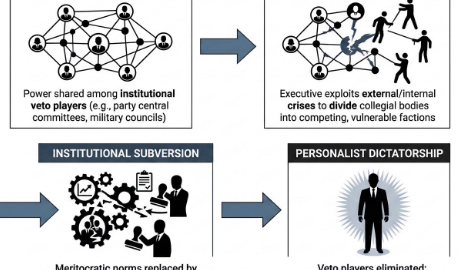
The Illusion of Democracy: Constitutional Manipulation and the Modern Dictator
How Modern Dictators Hold Absolute Power
Sun, Nov 01 2026 /Mpelembe Media/ —A dictatorship is a system of governance where a single individual or political party wields absolute power, typically emerging during periods of severe social unrest or economic instability. Within these regimes, personal autonomy, political choice, and human rights are heavily suppressed, and democratic institutions as well as opposition parties are dismantled. Rulers maintain authority through coercion, intimidation, unlawful imprisonment, violence, and state apparatuses such as secret police or indefinite detentions. Furthermore, autocrats frequently manipulate legal frameworks to preserve control; for instance, constitutional amendments in Russia altered presidential term limits to allow Vladimir Putin to remain in power through 2036. While autocracies concentrate unchecked authority strictly within an individual—a category that historically encompassed benevolent rulers—dictatorships can disperse authority across a governing party or ruling circle and inherently feature severe abuses of power. Continue reading

Hidden Drivers of Depression in Zambia
Beyond Individual Risk: How Community Context and Structural Inequalities Shape Mental Health Across Zambia
Thu, July 29 2026 /Mpelembe Media/ — National epidemiological evidence from the 2024 Zambia Demographic and Health Survey (ZDHS) demonstrates that approximately 8.2% of Zambian adults aged 15–59 years—or roughly one in twelve people—screen positive for probable depression, probable anxiety, or both. Utilizing validated screening tools including the Patient Health Questionnaire (PHQ-9) and Generalized Anxiety Disorder scale (GAD-7), the study establishes a national baseline for a population where epidemiological evidence was previously scarce. Symptom prevalence shows a distinct age trajectory, rising steadily from 4.2% among adolescents aged 15–19 to a peak of 11.5% among adults aged 40–44. While Zambia’s overall baseline is moderate compared to regional neighbors such as South Africa (where probable depression reaches 25.7%), it reflects a substantial mental health burden that remains largely undetected and untreated due to severe healthcare workforce constraints, structural low priority, and widespread social stigma. Continue reading

Why Carrots and Sticks Destroy Motivation
Cultivating Autonomous Minds: Why External Incentives Undermine Deep Learning
Mon, July 26 2026 /Mpelembe Media/ — Ancient wisdom and modern psychological science converge on a fundamental truth: relying on external incentives like rewards and punishments represents a flawed foundation for genuine learning and human development. The ancient Chinese Daoist philosopher Zhuangzi famously observed that “rewards and punishment is the lowest form of education,” criticizing external carrots and sticks for treating individuals like animals driven by force rather than self-directed minds. Zhuangzi argued that external controls transform learning into a mere transactional exchange, replacing authentic curiosity and spontaneous inner transformation (ziran) with superficial compliance and fear. Demonstrating his commitment to personal freedom over external status, Zhuangzi famously rejected a prime ministership, choosing the unconstrained “mud” of an ordinary life over the gilded captivity of royal favor. Centering education around external rewards assumes that learners possess no internal direction, thereby extinguishing their natural drive toward mastery and moral self-cultivation. Continue reading

Why the CIA Intelligence Matrix Fails
From Upstream Scoping to Disproof Architectures: Mastering the Art of Adult Research
Fri Oct. 23, 2026 /Mpelembe Media/ — Developing a high-rigor independent research capability requires replacing unstructured curiosity with deliberate structural frameworks designed for time-constrained professionals. Unstructured exploration routinely collapses under its own cognitive weight due to an expanding volume of information, making upstream scoping and strict bounding essential. Effective inquiry begins by tapping into an intrinsic curiosity engine and reframing broad topics into narrow, diagnostic queries that define what data is relevant and what can be safely ignored. Proposed research projects must pass a “So What?” significance filter to evaluate their intellectual yield, while adjacent curiosities are deferred to a dedicated backlog so execution momentum remains intact. Research depth is ultimately governed by a pre-defined deliverable, establishing a clear stopping mechanism and preventing open-ended documentation. Continue reading

Google AX stops the AI taxi meter
Beyond Microservices: Why Autonomous AI Agents Demand a New Compute Paradigm
Sun 20 Sept 2026 /Mpelembe Media/ — Agentic workloads represent an entirely new compute paradigm that falls outside traditional cloud-native operational patterns. Unlike stateless microservices, which run as persistent processes with stable, predictable network traffic, or batch processing jobs, which execute linearly to completion with constant resource allocations, autonomous AI agents operate as stateful, long-running, and highly intermittent compute actors. An agent’s execution cycle typically consists of short bursts of intense localized computation—such as parsing context, executing generated code, or calling toolchains—punctuated by prolonged idle intervals spent awaiting remote model inference, tool execution returns, or human approvals. Continue reading

Why joblessness and diamonds fuel civil war
The Dual Private Sector Dilemma: Why IMF Market-Led Growth Models Fail to Create Jobs in Fragmented African Economies
Mon, Aug 24 2026 /Mpelembe Media/ — The economic relationship between sub-Saharan Africa and the International Monetary Fund (IMF) has its roots in the 1944 Bretton Woods Conference, where the few developing nations present failed to secure explicit references to their development financing needs in the Articles of Agreement. From its inception, the IMF maintained a rigid, short-term balance-of-payments focus, famously denying Ethiopia’s first request for financial assistance on the grounds that its needs were neither immediate nor temporary. By the 1980s and 1990s, this short-term framework was formalized into neoliberal Structural Adjustment Programs (SAPs), which mandated strict conditionalities such as market deregulation, extensive privatization of state-owned enterprises, and rapid trade opening. Although promoted as pathways to long-term macroeconomic stability, these interventions frequently triggered severe adverse social consequences, including declining real wages, heightened poverty, and the systematic deterioration of basic health and social welfare systems. In response to widespread critique in the late 1990s, the IMF purported to shift its operational model, replacing traditional SAPs with the Enhanced Structural Adjustment Facility (ESAF) and, subsequently, various credit facilities under the Poverty Reduction and Growth Trust (PRGT). However, empirical evidence indicates that these contemporary programs represent “SAPs in disguise,” with loan conditionalities and stringency steadily rising, and core prescriptions of fiscal consolidation and state retrenchment remaining largely unchanged. Continue reading

Why innovation needs useless knowledge
The Power of Curiosity: Why “Useless” Knowledge is the Engine of Human Progress
Tue, July 28 2026 /Mpelembe Media/ — This is a comprehensive analysis of the distinction between basic and applied research, outlining their unique motivations, methodologies, and societal roles. Basic research is described as a curiosity-driven endeavor aimed at expanding the frontiers of human knowledge and establishing theoretical foundations without immediate concern for utility. In contrast, applied research focuses on utilizing existing scientific frameworks to engineer practical solutions for specific, real-world challenges. The articles emphasize that these two approaches exist on a dynamic continuum, where fundamental discoveries frequently pave the way for later technological and medical breakthroughs. By examining various disciplines such as medicine, social sciences, and engineering, the texts illustrate how a balanced research ecosystem relies on the symbiotic relationship between pure intellectual inquiry and targeted problem-solving. Ultimately, the collection highlights that while their timelines and goals differ, both forms of investigation are essential for continuous innovation and the advancement of the human condition. Continue reading

Inside the Agentic Enterprise of 2026
The Age of Autonomy: How Multi-Agent Systems are Redefining Enterprise AI in 2026
Tue, May 26 2026 /Mpelembe Media/ — In 2026, the technology landscape has firmly transitioned from conversational generative AI to autonomous, multi-agent AI ecosystems. Rather than waiting for step-by-step human prompts, these AI agents can independently reason, plan, use tools, and collaborate to execute complex workflows across enterprise systems. Continue reading

Why Quantum Computing Starts in the Dirt
Vying for Quantum Supremacy: National Strategies of the US, UK, and China
Fri, May 22 2026 /Mpelembe Media/ — The global race for quantum technology is a high-stakes competition poised to revolutionize major industries, including healthcare, finance, clean energy, and national defense. This “second quantum revolution” relies on principles like superposition and entanglement to solve highly complex optimization problems exponentially faster than classical supercomputers. However, the technology also presents profound national security risks, particularly the potential to eventually break the cryptographic infrastructure that currently secures global communications and financial data. Continue reading